
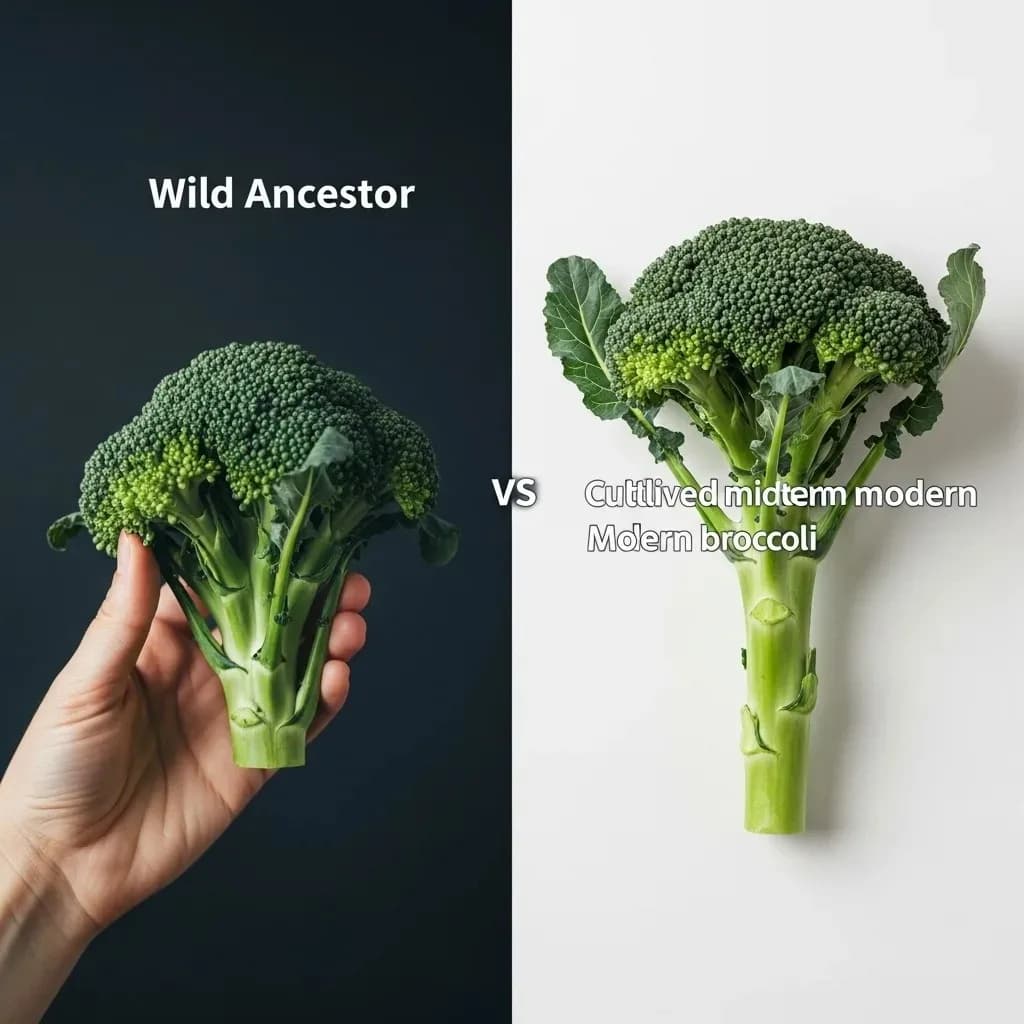
Did Broccoli Grow Naturally?
No. Broccoli does not exist in the wild. What does exist is a coastal plant called Brassica oleracea, a wild cabbage that grows along the Mediterranean and Atlantic coasts of Europe. It has small, tough leaves and a bitter taste. Nothing like what you see at the market today.
Farmers in what is now Italy started selecting the plants with the thickest stems and biggest flower buds around the 6th century BCE. Cornell University's master gardener program traces these origins to early Mediterranean cultivation linked to Etruscan farming communities. They saved seeds from the best plants, grew them again, picked the best again, and did this over and over for generations. Slowly, a new plant emerged. That plant became what we now call Calabrese broccoli, named for Calabria in southern Italy.
The word “broccolo” in Italian means “flowering crest of a cabbage.” The scientific name, Brassica oleracea var. italica, literally translates to “Italian cabbage.” So broccoli is named for what it is: a human-designed version of an old Italian plant.
Is Broccoli a GMO?
No. This is the question Adam eventually asked me, and it is a fair one. GMO means genetically modified organism, a plant whose DNA is directly edited in a lab using techniques like gene splicing. That technology did not exist until the 1970s.
Selective breeding is different. You do not touch DNA. You choose plants with the traits you want, let them reproduce, and repeat the process over many generations. It is slow. It takes decades. But it is completely natural in the sense that the plants cross-pollinate the way they normally would. No lab. No injections. No genetic sequences written by a scientist.
Broccoli is non-GMO under all international standards. What it is, is a cultivar: a cultivated variety that humans shaped through centuries of patient farming.
What Other Vegetables Are Man-Made the Same Way?
This is the part that genuinely surprised me when I first read about it. Broccoli, cauliflower, kale, Brussels sprouts, cabbage, kohlrabi, and romanesco are all the same species. They all came from that one wild cabbage plant, Brassica oleracea. Farmers just shaped each one differently by selecting for different parts of the plant.
One plant, six vegetables
- Kale: leafy parts were selected and emphasized
- Cabbage: a dense head of leaves was the target
- Cauliflower: white flower heads, grown by choosing plants that develop in their own shade
- Brussels sprouts: small axillary buds along the stem
- Kohlrabi: the swollen stem became the feature
- Broccoli: the green flowering head and thick stalk
Alfi, who is younger than Adam, went through a phase of refusing Brussels sprouts. I will wait until he is a little older before explaining they are basically the same thing.
When Did Broccoli Come to the United States?
Italian immigrants brought broccoli to the US in the 1800s. It did not catch on commercially until the 1920s. The D'Arrigo Brothers Company started test marketing broccoli in California and New York in 1923. From there, it spread. By 2022, a Green Giant survey named it America's favorite vegetable.
Pliny the Elder mentioned a vegetable called “cyma” in the 1st century CE, which historians believe was an early broccoli or close relative. The Romans cultivated it widely, then it moved through Europe over the following centuries. England got it in the 1720s. The United States came much later, and even then it took another century to reach mainstream grocery stores.
Is Man-Made Broccoli Still Healthy?
Yes. And this was the real question I had that night after Adam's school story. The man-made origin does not change the nutritional reality.
Per 100 g raw broccoli (USDA FDC 170379)
- Vitamin C: 89.2 mg, about 68% more than an orange (which has roughly 53 mg)
- Vitamin K: 102 mcg
- Fiber: 2.6 g
- Plus folate, potassium, calcium, and iron in meaningful amounts
The vitamin C figure matters practically. Boiling strips roughly half of it. Steaming or eating broccoli raw preserves far more. I switched to steaming years ago, mostly for this reason.
Broccoli also contains glucoraphanin, which your body converts to sulforaphane using an enzyme called myrosinase. Research from Johns Hopkins in 1997 found that broccoli sprouts contain 20 to 50 times more glucoraphanin than mature broccoli. As of 2024, a meta-analysis identified 202 clinical trials on broccoli and sulforaphane, with 84 meeting clinical intervention criteria. Research suggests sulforaphane has antioxidant and anti-inflammatory properties. I am not saying broccoli treats or cures anything. The research does not say that either. But the compound is being studied seriously across multiple conditions.
Selective breeding shaped how the plant looks and tastes. The nutrients are a product of the plant's own biology, not of human engineering.