How to Microwave Broccoli

Adam ate broccoli exactly one way for almost three months in late 2023: microwaved, soft, with butter. Not roasted. Not stir-fried. Microwaved. I made it wrong at least a dozen times before I got it right. Too much water and it went completely soggy. Lid not sitting flat and it came out raw in the middle. Four minutes in our 950W Singapore microwave and the whole kitchen smelled like a wet dog. That was a painful phase. But by the end of it, I knew exactly what works and exactly what does not. Here is everything I learned from making it badly first.
Key Takeaways
- Cook time: 3 minutes at 1000W; 3.5 minutes at 700-800W; 5 to 5.5 minutes for frozen
- Water: exactly 2 tablespoons. More water boils the broccoli and makes it soggy.
- Bowl must be no more than two-thirds full so the plate sits completely flat
- Microwaving retains 84% of vitamin C vs 67% after boiling (PMC2722699)
- Chop broccoli 40 minutes before cooking to activate more sulforaphane
How to Microwave Broccoli: Step-by-Step
1. Cut the florets, and use the stems.
Chop into 1.5 to 2 inch pieces and keep them similar in size. Slice the thick stem into half-inch rounds. Do not throw those away.
2. If you have 40 minutes, chop first and wait.
Once cut, an enzyme called myrosinase activates and converts glucoraphanin into sulforaphane. High heat kills that enzyme before it can finish. Chop the florets, wait 40 minutes, then microwave. Research suggests this method raises sulforaphane availability significantly compared to cooking immediately (PubMed 32328271). Not always practical on a weeknight, but worth knowing.
3. Use the stem-raft technique.
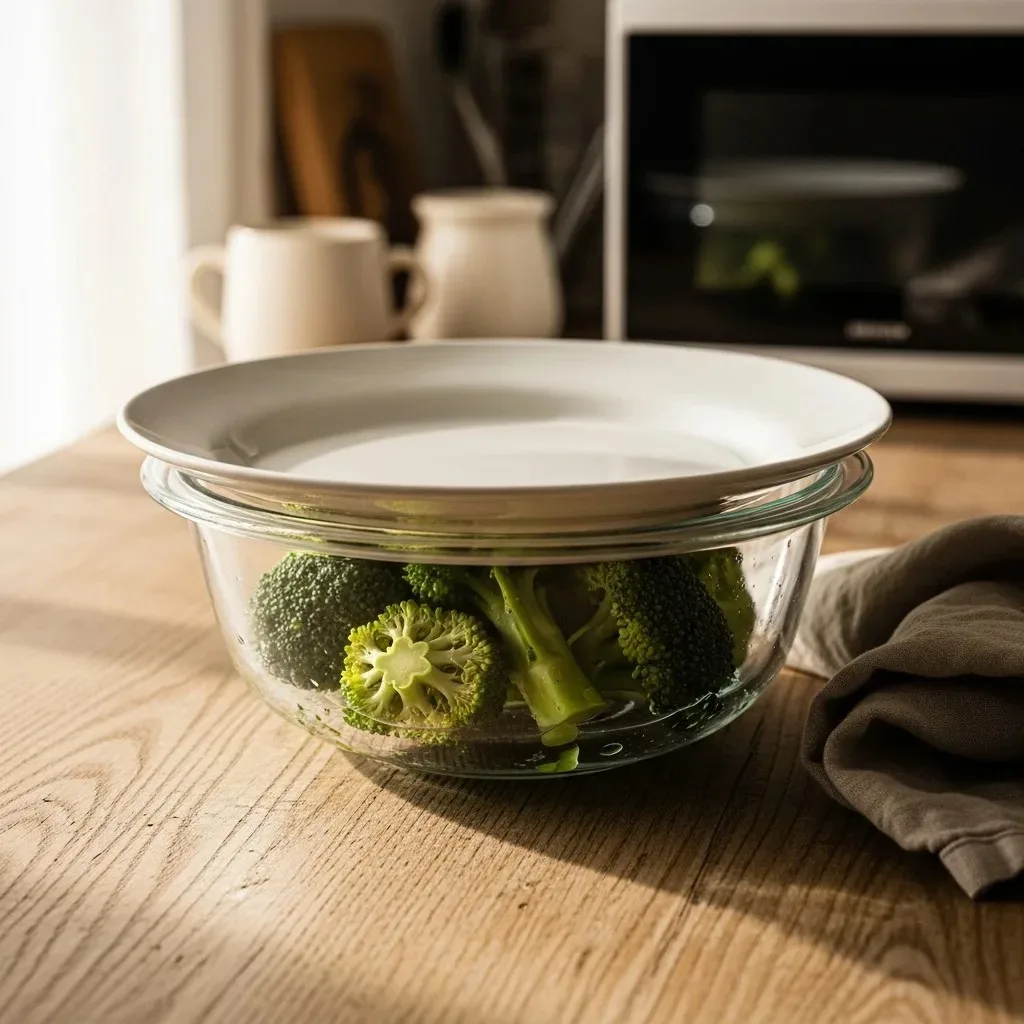
Put the stem rounds in the bottom of your bowl. Add 2 tablespoons of water. Stack the florets on top. The stems sit in the water. The florets sit above it and steam rather than boil. Brighter color, better texture. I picked this up from Cardamom and Tea and it genuinely changed the results for me.
4. Do not overfill the bowl.
This was my biggest mistake for weeks. If the bowl is more than two-thirds full, the plate cannot sit completely flat. Steam escapes from the gap. Some florets come out soft, some raw. Use a wide bowl that is only two-thirds full.
5. Cover and microwave.
Place a large flat dinner plate on top. No plastic wrap needed. Microwave on high:
- Fresh florets at 1000W: 3 minutes
- Fresh florets at 700-800W: 3.5 to 4 minutes
- Frozen florets, straight from the bag: 5 to 5.5 minutes
- Fresh riced broccoli: 3 to 3.5 minutes
Start at the lower end. You can always add 30 seconds.
6. Wait 2 minutes before opening.
Residual steam keeps cooking the broccoli after the microwave stops. If you lift the plate immediately, you release that heat and the centers can be undercooked. Wait the full 2 minutes, then tilt the plate away from you when you lift. Steam burns.
7. Season while hot.
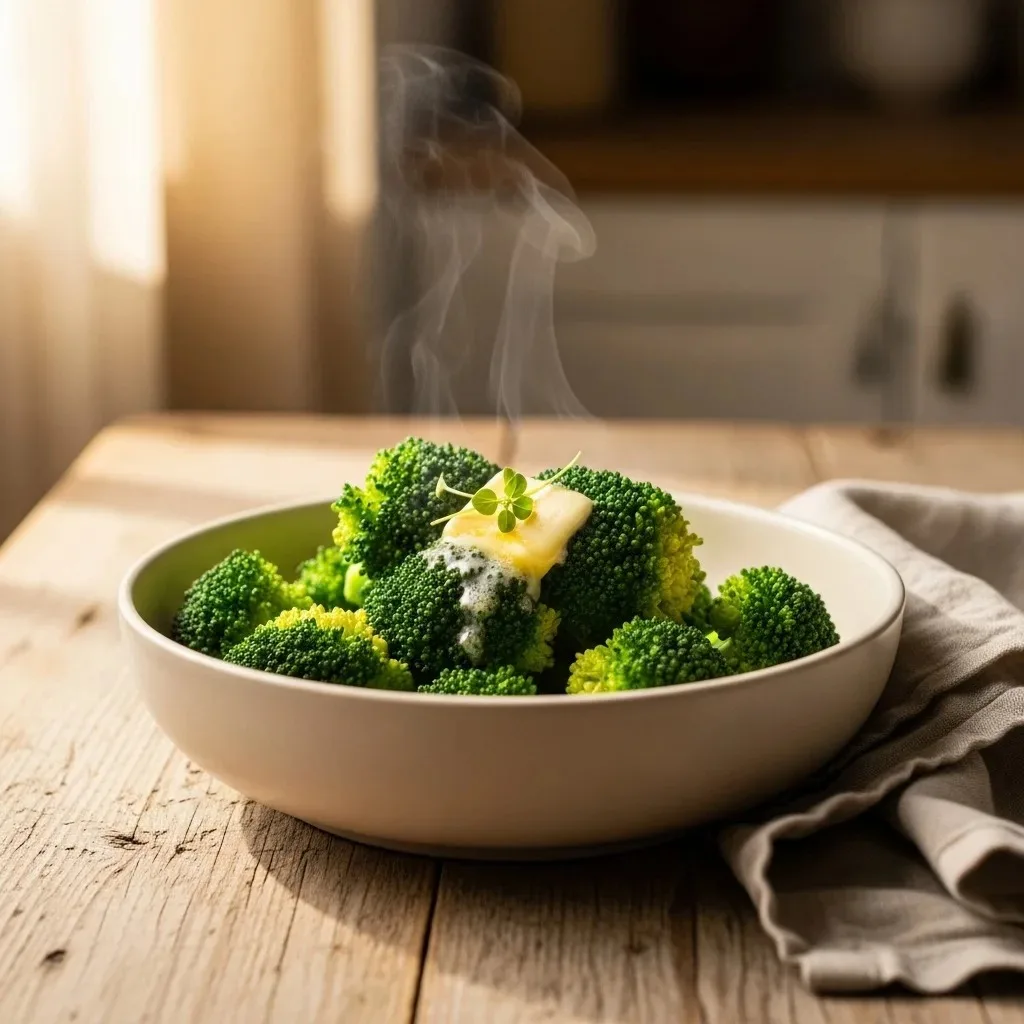
Drain any water at the bottom. Butter, flaky salt, a squeeze of lemon. Alfi prefers garlic butter. Adam still wants plain butter. The simple things.
Why This Method Works
The microwave heats water molecules inside the broccoli directly, creating steam from within the vegetable itself. The plate traps external steam and turns the bowl into a sealed cooking environment. Short cook time, minimal water, and you get that bright green color that disappears the moment you overcook it.
Boiling broccoli for more than a minute destroys myrosinase entirely, meaning no sulforaphane production at all (PubMed 32328271). A 2020 study in Food Science and Nutrition found that moderate microwave heating around 60 degrees Celsius with limited water raised bioavailable sulforaphane yield by approximately 80% compared to conventional heating. High-power microwave cooking around 950W produced 40% more sulforaphane than low-power methods (PubMed 32328271).
On vitamin C: microwaving retains 84% vs 67% after boiling (PMC2722699). Carotenoids like lutein, zeaxanthin, and beta-carotene show no significant loss when microwaved, while boiling reduces them by 13% (PMC2722699). A small knob of butter actually helps your body absorb those carotenoids since they are fat-soluble. This is the nutritional case for not skipping the butter, which I find very satisfying as a reason.
Common Mistakes and What Actually Fixes Them
- Mushy broccoli
- Too much water or too long in the microwave. Use exactly 2 tablespoons. Check at 3 minutes.
- Raw in the middle
- The plate was not sitting flat. Bowl was too full. Fix the fill level.
- Wet dog smell
- Overcooked. The sulfur compounds release once broccoli goes past tender-crisp. Pull it earlier.
- Uneven cooking
- Florets cut to different sizes. Cut everything the same size.
Frequently Asked Questions
Can you microwave broccoli without water?
Yes. Drizzle with olive oil, season with garlic and salt, and microwave uncovered for 3 to 5 minutes. The texture is slightly drier and the florets pick up a little more color and crispness at the edges. It is a different result from the steam method. Honestly, for flavor it is quite good when I want something closer to roasted without turning on the oven. The key is removing it from the microwave immediately when done, because it keeps cooking in the residual heat from the bowl.
How do you keep microwaved broccoli from getting mushy?
Use less water and less time than you think you need. Two tablespoons maximum. Start at 3 minutes at 1000W. Let it finish in the residual steam rather than extending the microwave time.
Is microwave broccoli healthy?
Microwaving is one of the better cooking methods for broccoli, not one of the worst. It retains more vitamin C than boiling, preserves carotenoids well, and with the chop-first technique, produces good sulforaphane yields. Research frames it as comparable to steaming for most nutrients when you use minimal water and short cooking times (PMC2722699, PubMed 32328271).
Can you microwave frozen broccoli without defrosting?
Yes. Straight from the bag into a bowl with 2 tablespoons of water. Cover with a plate. 5 to 5.5 minutes on high. Check at 5 minutes. The florets should be bright green and tender.
How much water do you use to microwave broccoli?
Use exactly 2 tablespoons. More water boils the broccoli rather than steaming it, which results in soggy florets and greater nutrient loss. The small amount creates steam in the sealed bowl without submerging the broccoli.