How to Sauté Broccoli on the Stove
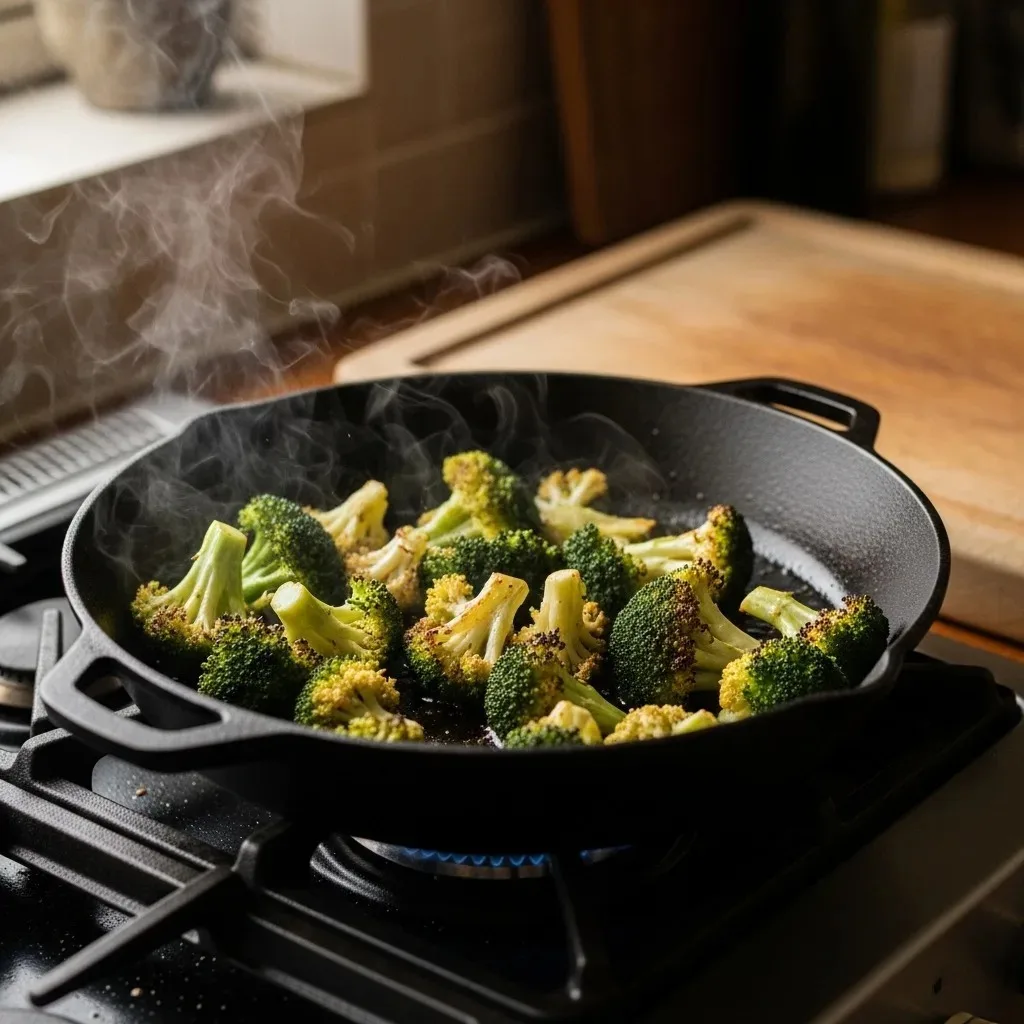
Adam went three months refusing broccoli when he was five. Not all vegetables, just broccoli. The texture was the problem: slimy, grey-green, smelling of school canteen. I had been steaming it wrong the whole time and blaming him for it. Then one night I tried sautéing it instead. He finished the whole bowl and asked what I did differently. That question is why this page exists.
Key Takeaways
- ✓Cook time: 6 to 8 minutes total on medium-high heat
- ✓Use cast iron or stainless steel, not nonstick, for proper browning
- ✓Sear undisturbed for 2 minutes first before adding water
- ✓Add garlic powder with the florets, or fresh garlic in the last 60 seconds only
- ✓Pull off heat while still vibrant green, not grey-yellow
Step-by-Step: Sautéing Broccoli on the Stove
What you need: 1 head broccoli (about 4 cups florets and sliced stalk), 2 tablespoons olive oil, 2 tablespoons water, ½ teaspoon garlic powder, ½ teaspoon salt, black pepper, juice of half a lemon.
Step 1: Prep the florets and stalk
Cut the head into even florets. Keep them similar in size so nothing finishes before the rest. Do not throw the stalk away. Peel the tough outer skin with a knife and slice into ¼-inch coins. The stalk is milder and slightly sweet and is rich in prebiotic fibre. It just needs a 30-second head start in the pan.
Step 2: Dry the broccoli
Pat everything dry with a paper towel after washing. Wet broccoli in hot oil spits and steams rather than sears. You need dry surfaces to get browning.
Step 3: Heat the oil until shimmering
Place your skillet over medium-high. Add 2 tablespoons of olive oil. Wait until it shimmers when you tilt the pan, about 90 seconds. Do not add broccoli to cold oil. Cold oil means the florets sit in fat and absorb it rather than browning.
Step 4: Add stalk first, then florets cut side down
Add stalk coins first for 30 seconds, then add florets cut side down in a single layer. If your pan is crowded, cook in two batches. Piled-up florets trap steam and you lose the char.
Step 5: Sear without touching for 2 minutes
Do not stir. Do not shake the pan. Two minutes of contact is where the flavour develops. When florets lift easily and show golden or dark green-brown spots on the flat side, they are ready.
Step 6: Add water and cover immediately
Have the lid in your other hand. Add 2 tablespoons of water to the pan and cover at once. The steam reaches all the curved surfaces the pan cannot touch. Steam for 2 minutes.
Step 7: Uncover, season, and serve
Remove the lid. Let residual liquid evaporate, about 30 to 60 seconds. Add garlic powder, salt, and pepper. Toss once. Squeeze lemon over the top and get it on the plate fast. Broccoli keeps cooking from the heat already in it.
Why Sautéing Works Better Than Steaming or Boiling
The sear builds flavour that steaming cannot. When broccoli hits a hot pan and stays still, the Maillard reaction browns the cut surface, the same chemistry behind good toast or a good steak. Low heat steams. High heat browns.
Steam solves the geometry problem. Broccoli florets are uneven. The pan browns the flat side. Steam wraps around the rest. That is why you need both steps.
Colour is your signal. Vibrant, jewel-like green means the chlorophyll has released properly and the cooking is in the right window. Grey or yellow means those pigment structures have broken down. Get it off the heat the moment it looks bright.
One thing that surprises most people: broccoli contains a compound called glucoraphanin that converts to sulforaphane when you chop it, activated by the enzyme myrosinase. Research suggests heat above roughly 70°C degrades myrosinase, which reduces sulforaphane yield. [1] A short saute limits this compared to boiling. Pre-chopping and resting the broccoli for a few minutes before cooking preserves more of it.
Common Mistakes
Adding fresh garlic too early.
Fresh garlic burns before the broccoli is done. Use garlic powder if you want it in from the start, or add fresh garlic in the last 60 seconds only.
Stirring right away.
Moving the florets before 2 minutes breaks the contact and kills any chance of browning.
Crowding the pan.
Too many florets and steam builds up between them. Cook in batches if needed.
Using nonstick.
Nonstick surfaces prevent sticking, which also prevents browning. Cast iron or stainless steel are the right tools here.
Frequently Asked Questions
Should I boil broccoli before sautéing it?
No. Boiling waterlogged florets before they hit the pan means you cannot get any sear at all. The steam step in this method handles the tenderising without that problem.
Why do you add water when sautéing broccoli?
Water creates steam, which wraps around the irregular shape of the florets from all angles. The pan gets the flat cut surface. Steam gets everything else. Without it, you get browned bottoms and raw tops.
Should I use garlic powder or fresh garlic?
Garlic powder goes in at any point without burning. Fresh garlic needs the last 60 to 90 seconds of cooking only, otherwise it burns on a hot pan and turns bitter.
Can I sauté frozen broccoli?
You can, but expect softer results. Frozen florets release a lot of water as they thaw, which prevents browning. If you use frozen, thaw and pat dry first. Fresh broccoli is better for this technique.
Does sautéing broccoli destroy its nutrients?
Sautéing retains more than boiling. When you boil broccoli, water-soluble vitamins including vitamin C and folate leach into the cooking water and get discarded. Sautéing keeps the broccoli dry, so those nutrients stay in the floret. Raw broccoli contains approximately 89.2mg of vitamin C per 100 grams (USDA FDC 170379). [2] Short dry-heat cooking like sautéing preserves more of that than boiling does.
References
- [1] Van Eylen, D., Oey, I., Hendrickx, M., & Van Loey, A. (2008). Kinetics of myrosinase activity and glucosinolate degradation in broccoli (Brassica oleracea L. cv. Italica) at constant and varying temperatures. Food Chemistry, 110(4), 904–915.
- [2] USDA FoodData Central, FDC ID 170379. Broccoli, raw, per 100g: Vitamin C 89.2mg (99% DV), Vitamin K 101.6mcg (85% DV), Folate 63mcg. fdc.nal.usda.gov