Broccoli vs Kale: Which One Actually Wins?

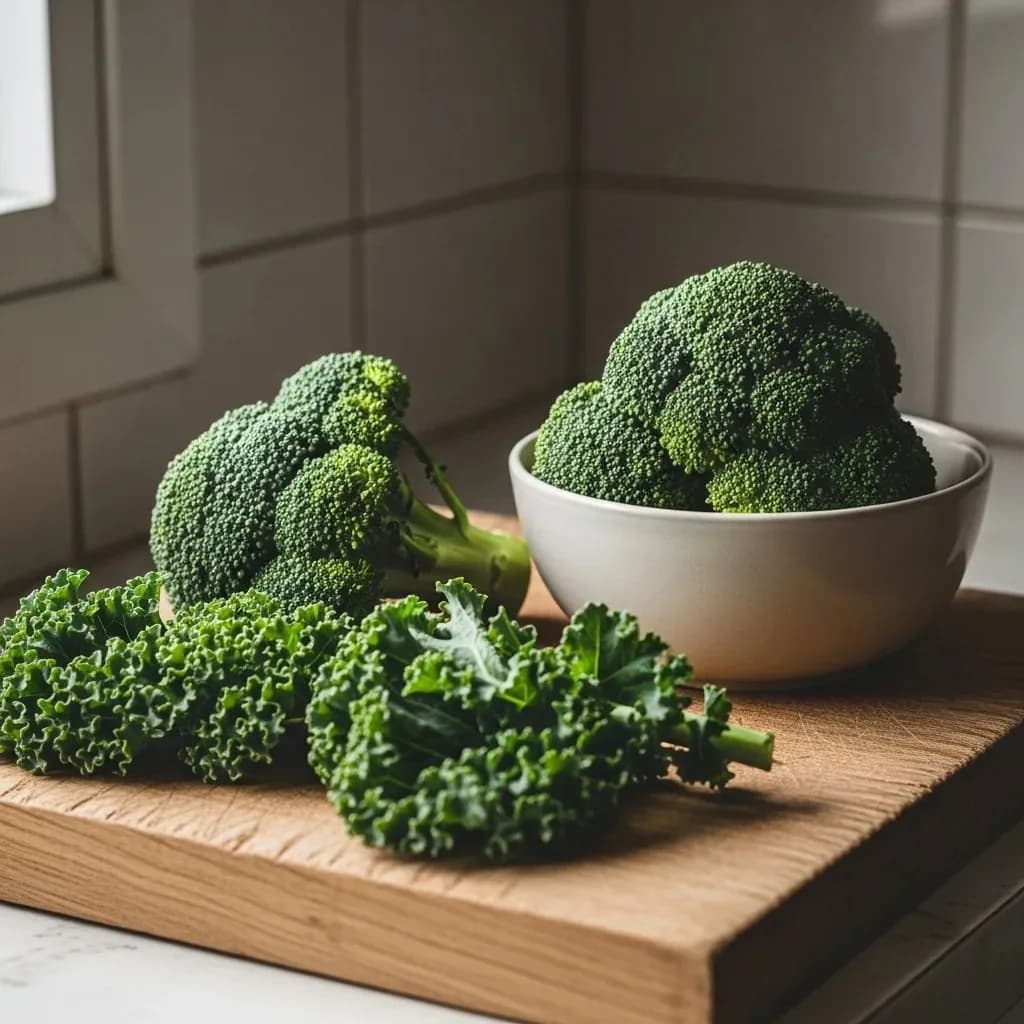
For two years I fed Adam broccoli florets with soy sauce and quietly ate the kale myself. He is seven and has declared kale “a leaf that tastes like a mistake,” so I stopped fighting that battle. But for two years I also assumed he was missing out on the better vegetable, because kale costs more at Cold Storage, it is darker green, and every wellness account on my feed treats it like a gift from the earth. Then I actually sat down with the USDA numbers and realised I had been making assumptions instead of reading data.
Which has more vitamin C, broccoli or kale?
Broccoli wins this, and it is not close. Per 100g raw, broccoli gives 89.2mg of vitamin C, which is 99% of your daily value (USDA FDC 170379). Kale per cup raw delivers about 22% DV (USDA FDC 168421). That is a real gap.
The catch: boiling broccoli wipes out a significant portion of that vitamin C. Light steaming or roasting keeps more of it. When I make it for Adam I steam it for four minutes, not boil it.
Which has more vitamin K, broccoli or kale?
Kale by a large margin. Kale contains around 817mcg of vitamin K per 100g raw versus 102mcg for broccoli (USDA FDC 170379). That is roughly 681% of the daily value for kale versus 85% for broccoli (USDA FDC 168421).
Vitamin K matters for blood clotting and bone density. If you are on warfarin or any blood thinner, this is the number your doctor needs to know about. You do not have to avoid kale, but dramatic changes to intake can interact with that medication.
Does cooking destroy sulforaphane in broccoli?
This is the detail nobody in the top search results explains properly.
Broccoli does not contain sulforaphane directly. It contains glucoraphanin, a precursor compound (USDA FDC 170379; glucosinolate profile data). When you chop or chew raw broccoli, an enzyme called myrosinase converts glucoraphanin into sulforaphane. That is where the benefit happens.
The problem is heat. Boiling broccoli above roughly 70°C destroys myrosinase (MD Anderson Cancer Center, referenced via fivejourneys.com, 2023). No myrosinase, no conversion. You still get nutrients, but you lose what makes broccoli distinctive among cruciferous vegetables.
Add a small pinch of mustard seeds to cooked broccoli. Mustard contains myrosinase that survives cooking and performs the glucoraphanin conversion. Broccoli sprouts, meanwhile, contain 10 to 100 times more glucoraphanin than mature broccoli (research suggests, per Johns Hopkins Brassica Chemoprotection Laboratory studies). A tablespoon of sprouts may outperform a full cup of cooked florets for this specific compound.
Kale has glucosinolates too, but at lower concentrations than broccoli. For sulforaphane specifically, broccoli is the right choice.
Is kale safe if you have thyroid problems?
There is a lot of alarming content online about this. Here is the practical answer.
At normal eating levels of 2-3 servings of cruciferous vegetables per day, the main effect is that you need slightly more iodine. That is it. Research suggests the threshold for goitrogenic effects at normal dietary intake is extremely high (Masterjohn C. 2020, citing prior animal study literature). That threshold data comes from animal experiments, and no equivalent human data exists to define a precise limit.
The practical fix is simple: eat some seafood. Nori, kombu, or any seaweed also works. I started adding a small strip of dried kombu to our soup stock, which has zero flavour impact. Raw cruciferous vegetables have more glucosinolate activity than cooked, so if you are managing a thyroid condition, cook your kale and broccoli rather than eating them raw.
Can you eat broccoli and kale every day?
For most people, yes. The concern is real but routinely overstated.
Jorge Cruise, a nutrition author, appeared on NewsNation in 2023 arguing that kale and broccoli contain plant defense compounds that can inhibit nutrient absorption. The mechanism he describes is real (glucosinolate-mediated iodine competition), but research suggests that at moderate servings the practical effect is minimal for most healthy adults. The main concern at daily intake remains the iodine point noted above.
For kids, the daily question is a different kind of practical problem. Alfi will eat kale if I roast it into chips with olive oil and sea salt. Adam will eat broccoli steamed with soy sauce. I gave up on making them eat the same vegetable at the same time.
Broccoli vs Kale: Nutrient Comparison (per 100g raw)
Source: USDA FoodData Central — FDC ID 170379 (broccoli), FDC ID 168421 (kale, raw); calcium data via versus.com citing USDA
| Nutrient | Broccoli | Kale | Higher |
|---|---|---|---|
| Calories | 34 kcal | 49 kcal | Broccoli (lower) |
| Protein | 2.82g | 4.28g | Kale |
| Fiber | 2.6g | 3.6g | Kale |
| Vitamin C | 89.2mg (99% DV) | ~22% DV | Broccoli |
| Vitamin K | 102mcg (85% DV) | 817mcg (681% DV) | Kale |
| Vitamin A | 31mcg RAE | 500mcg RAE | Kale |
| Calcium | 47mg | ~150mg | Kale |
| Folate | 63mcg (16% DV) | Lower | Broccoli |
| Sulforaphane potential | High (glucoraphanin-rich) | Moderate | Broccoli |
| Lutein + Zeaxanthin | 1,400mcg | Present | Similar |
Frequently Asked Questions
Which has more protein, broccoli or kale?
By raw weight, kale has more: 4.28g per 100g versus broccoli's 2.82g (USDA FDC 170379; USDA FDC 168421). Per cooked cup, values converge because kale wilts significantly in volume.
Does kale have more calcium than broccoli?
Yes, substantially. Kale has roughly 4.36 times more calcium per 100g than broccoli by weight (USDA data via versus.com). One cup cooked kale provides close to 100mg calcium. Research suggests kale's calcium is bioavailable and not significantly blocked by oxalates, unlike spinach calcium.
Which is better for weight loss, broccoli or kale?
Both are extremely low in calories: broccoli 34 kcal per 100g raw, kale 49 kcal per 100g raw (USDA FDC 170379; USDA FDC 168421). Broccoli has slightly more fiber per cup cooked. For weight management the difference is negligible. Pick the one you will actually eat.
Is there a downside to eating too much kale?
At very high quantities, specifically daily juicing of 10 or more servings, kale glucosinolates can theoretically interfere with iodine absorption. At 1-3 daily servings the practical effect is a modestly increased iodine requirement, which regular seafood consumption covers. Kale also contains oxalates. Anyone with kidney stone history should discuss intake with a doctor.
Sources
- USDA FoodData Central FDC ID 170379 — Broccoli, raw
- USDA FoodData Central FDC ID 168421 — Kale, raw
- versus.com — Broccoli vs Kale calcium comparison (USDA-sourced data)
- fivejourneys.com — Sulforaphane and cooking method research, referencing MD Anderson Cancer Center guidance
- Masterjohn C. (2020). “How much spinach, broccoli, and kale is too much?” YouTube, Chris Masterjohn PhD channel
- NewsNation (2023). Interview with Jorge Cruise on plant defense compounds in cruciferous vegetables