
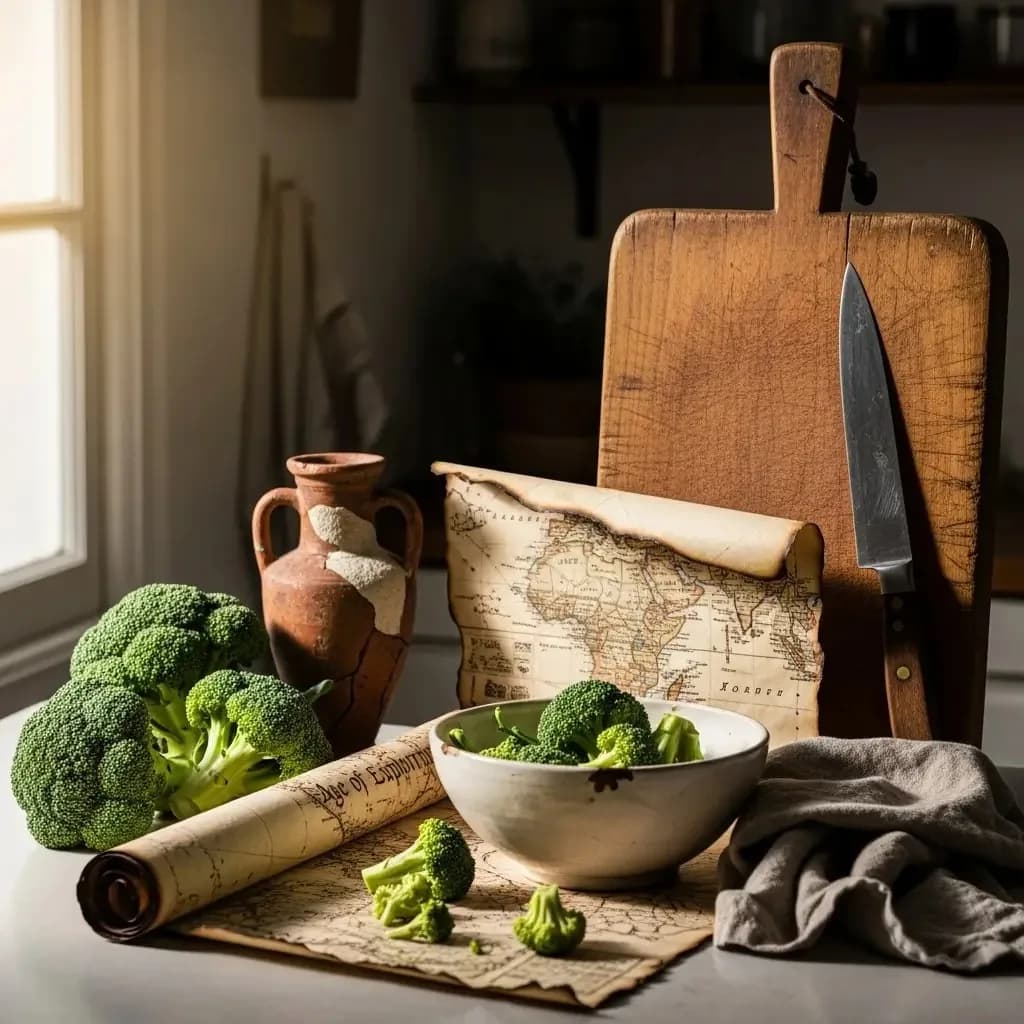
Did Broccoli Ever Grow in the Wild?
No. This is the part most people do not expect. Broccoli does not exist in nature.
It started with wild cabbage, Brassica oleracea, a scraggly coastal plant native to the Mediterranean and Asia Minor. By itself it is unremarkable. Etruscan farmers in what is now Tuscany saw something in it around 600 BCE. They bred it to develop dense, compact flower heads before the plant flowered and turned tough. Over generations, selecting for those tight green florets and edible stems, they created something that had not existed before.
The Romans took it further. Pliny the Elder wrote about a plant called cyma in his Naturalis Historia (c. 77 CE), and most food historians read this as an early form of broccoli. Romans ate it boiled with spices, olive oil, and wine. It was a kitchen staple.
Did you know?
Broccoli and cauliflower are genetically almost indistinguishable to botanists. Same species, Brassica oleracea, shaped in two completely different directions. One went white and compact, one stayed green and tree-shaped.
When Was Broccoli First Eaten?
The Etruscans were selecting for early broccoli forms around 600 BCE. By the 1st century CE, Roman writers were documenting it as established food. That makes broccoli roughly 2,600 years old as a cultivated vegetable.
Its scientific name, Brassica oleracea var. italica, was formally assigned in 1794 by botanist Joseph Jakob von Plenck. The word broccoli comes from the Italian broccolo, meaning “flowering crest of a cabbage,” from brocco, arm branch. Alfi's “tiny tree” and the Roman “flowering crest” are describing the same geometry, two and a half millennia apart.
How Did Broccoli Spread Across Europe?
For most of those centuries, broccoli stayed in Italy. That changed in 1533 when Catherine de Medici of Florence married Henry II of France, arriving in Paris with Italian chefs and Italian vegetables. Broccoli came with her.
It reached England in the 1700s, where it was called “Italian asparagus.” For anyone with northern European ancestry, broccoli is a very recent food. Southern Europeans had been eating it for over two thousand years before northern Europeans ever saw it. Year-round availability is an industrial-era development. Broccoli was historically a fall vegetable.
Thomas Jefferson grew it at Monticello from seeds imported from Italy, starting in 1767. It never spread from his garden into American cooking. It remained a curiosity.
Who Brought Broccoli to America?
Two groups of people, and the second is almost never mentioned.
Stefan and Andero D'Arrigo, brothers from Messina in Sicily, planted broccoli in San Jose, California in the 1920s. They shipped the first crates by refrigerated rail car to the Italian immigrant community in Boston. It sold out immediately. Italian-Americans recognized what they were buying.
But what brought broccoli into mainstream American kitchens was Japanese farmers in California. In the 1930s, those farmers had been pushed out of other crops by racial discrimination. Broccoli was available to them, and they farmed it at scale. That expanded supply was what made it accessible to everyday American kitchens.
Timeline correction
Most Americans did not see broccoli regularly until the mid-to-late 1930s. The standard claim that it went mainstream “in the 1920s” is not quite right. Closer to 1935 to 1940.
Why Do Broccoli, Kale, and Cauliflower Look So Different?
They all come from Brassica oleracea, wild Mediterranean cabbage. Kale selected for leaf growth. Cauliflower went white and compact. Broccoli went to dense green florets on branching stems. Brussels sprouts selected for buds along the stalk. Same starting point, completely different destinations, shaped by what farmers wanted. They are long-lost cousins who look nothing alike because humans had completely different plans for each of them.
What About George H.W. Bush?
He hated broccoli so much he banned it from Air Force One entirely. Not from his own plate. From the plane. He announced this in 1990. Broccoli farmers responded by shipping truckloads to Washington. Two and a half thousand years after the Etruscans invented it, this vegetable still divides a room.
Does Broccoli Actually Have More Vitamin C Than an Orange?
Yes. Raw broccoli contains 89.2 mg of vitamin C per 100g (USDA FDC 170379), compared to about 53 mg per 100g for a navel orange. One cup of chopped broccoli has roughly as much vitamin C as an entire orange. I spent years trying to keep Adam and Alfi healthy on the road, and this still surprises me. The vegetable they most wanted to reject was doing more for their immune systems than the fruit they actually wanted.
Sulforaphane forms when you chop or chew broccoli: myrosinase converts glucoraphanin, and the compound releases. Research suggests sulforaphane is among the most studied compounds of its kind in any vegetable. (MD Anderson Cancer Center) Broccoli sprouts grown for three days contain 20 to 50 times more glucoraphanin than mature broccoli. (Talalay et al, Johns Hopkins, PNAS 1997) These are research findings, not cure claims. The science is real and still ongoing.
The Etruscans built something that survived 2,600 years not because of marketing. Because it is good food.