Which grilling setup is best?
This method uses a metal grill basket with holes small enough to hold the florets. It avoids balancing little pieces directly across the grate. Use a basket approved for your grill and follow its instructions for loading, handles and heat limits.
Direct-grate broccoli needs larger cuts and different turning care. A closed foil packet traps moisture and gives a softer result. Those are separate methods, not interchangeable containers for the same timing. The oven-roasting guide is a useful alternative when outdoor heat or weather makes grilling awkward.
Keep a cooler area available on the grill. With gas, adjust the burners according to the appliance instructions. With charcoal, arrange the fuel to leave a section with less direct heat. This gives you somewhere to move the basket before the broccoli blackens.
Ingredients and equipment
For approximately four side portions, prepare:
- 1 pound (450 g) trimmed fresh broccoli
- 1½ tablespoons (22 ml) olive oil
- ½ teaspoon fine salt
- ¼ teaspoon ground black pepper
- Optional lemon wedges, served separately
You also need a grill basket, long tongs, heat-resistant gloves, a bowl, a clean serving plate and a fork for checking the stems. Keep the serving plate separate from anything used for raw meat.
The broccoli weight is after removing unusable stalk ends. Peel tender stalk sections and slice them thinly, or save them for another dish. Avoid putting thick stalk coins beside tiny crown crumbs and expecting them to finish together.
How should broccoli be prepared?
Wash ordinary fresh broccoli under running water, then dry it well with a clean towel. The FDA recommends this approach, without soap or produce wash. Trim away damaged sections and discard rotten produce.
Cut the florets to roughly 1–1½ inches across. Split thick branches lengthwise. This is more useful than cutting every top into a perfect shape: it reduces the amount of firm stem that heat must reach while protecting the delicate buds from a long cook.
Use the floret preparation guide if the stalk branches are difficult to separate. Shake away loose crumbs, which are easy to scorch. Put the prepared pieces in the bowl and toss with the measured oil, salt and pepper just before grilling.
Grill-basket method
Allow approximately 10 minutes for preparation, plus grill preheating and an initial 8–14 minute cooking window. Grill type, wind, basket material and floret size affect the cooking time. Start checking early, then use the stem’s tenderness to decide when to stop.
- Preheat the grill to medium-high according to its manual. Aim for a lid-gauge reading around 400–425°F. The metal directly over a burner may be considerably hotter than that reading.
- Prepare a cooler zone. Set the approved basket on the grill as directed by its manufacturer. Use gloves whenever touching its handle; a handle outside the lid can still become dangerously hot.
- Spread the coated broccoli in a shallow layer. If the basket is tightly packed, work in batches. Close the lid when appropriate for your appliance.
- Check after about three minutes. Turn the broccoli with long tongs or move the basket as its instructions allow. Stay beside the grill rather than relying on a long timer.
- Continue checking and turning every two or three minutes. If oil drips cause a flare-up, move the basket to the cooler area. Do not pour water onto a gas grill.
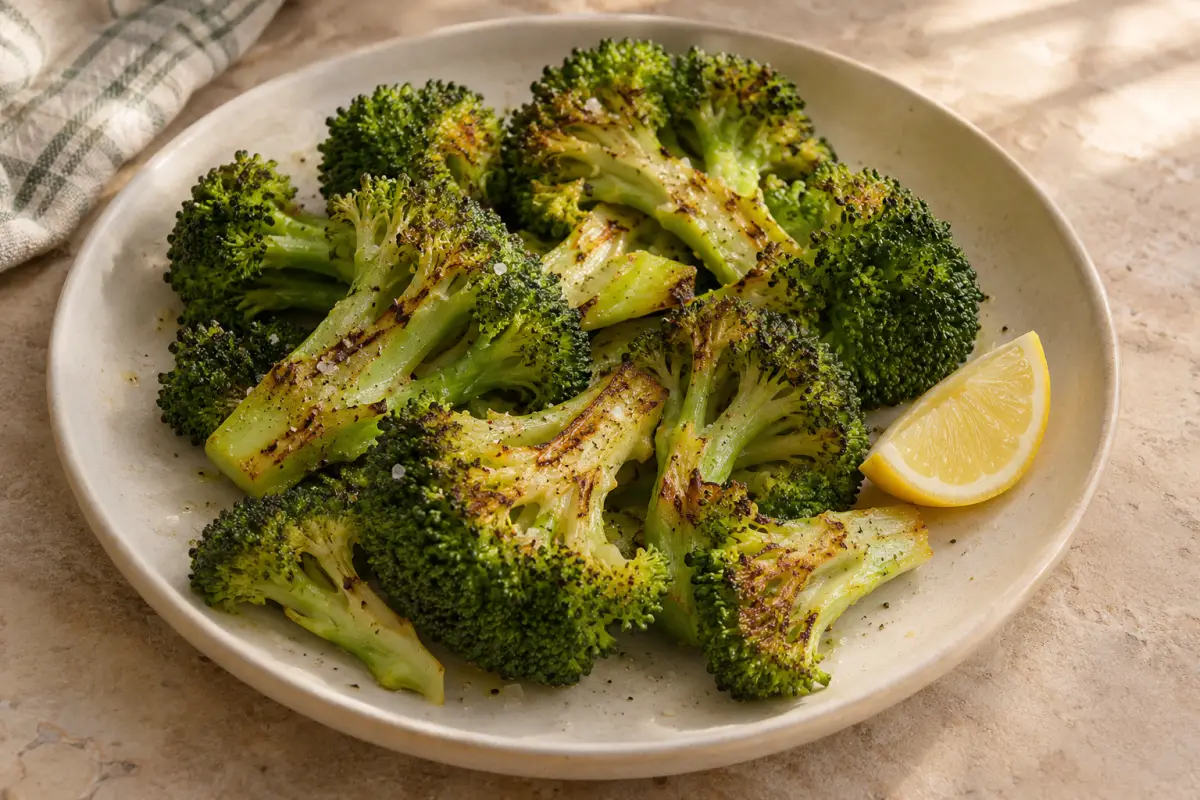
- Begin checking a thick stem with a fork around eight minutes. Remove the batch when stems are tender enough for your preference and the florets have light char. Continue briefly if the stems remain firm, using the cooler zone if necessary.
- Transfer to the clean plate. Taste a cooled piece, adjust seasoning and offer lemon wedges separately. No cheese or herbs are included in this plain version.
How do you fix uneven cooking?
Black tips with hard stems mean the outside is running ahead. Move the basket away from the strongest heat and continue checking. On the next batch, split thicker stems and reduce the direct heat. Adding more oil over the hot grill is not the answer.
Pale, wet broccoli may be crowded or insufficiently dried. Spread it out and give moisture room to escape. If the basket is too small, remove half the batch and cook it separately. Long cooking in a deep pile can soften the broccoli without giving evenly browned surfaces.
A few lost buds are normal during handling, but lots of broken pieces suggest rough turning or overcooking. Lift and roll the larger florets with tongs rather than pressing them flat against the basket.
Can this fit the rest of dinner?
Grill the broccoli in a separate basket away from raw meat juices. FoodSafety.gov's separation guidance calls for separate utensils and plates for raw and cooked foods. Use fresh tongs for serving if the original pair touched raw meat.
Serve the broccoli with the main course as soon as it is ready. If it finishes early, move it to a serving dish rather than leaving it over heat to keep collecting char. The cooler zone is a cooking tool, not a place to abandon vegetables indefinitely.
For advance preparation, cut the broccoli and keep it refrigerated, then add oil shortly before cooking. The storage guide explains the difference between storing whole heads and cut pieces. Keep the prepared pieces cold and covered, and dry off any surface moisture before seasoning them.
Where should you put the hot basket?
Put the empty serving plate and a clear landing space beside the grill before starting. Carrying a hot basket across a crowded table is awkward, especially when its handle stays hot after removal. Use gloves, stable surfaces and long utensils, and keep children away from the cooking area.
Common questions
Can frozen broccoli go in the basket?
Ice, moisture and small pieces change how frozen broccoli behaves in a basket. Start with the frozen broccoli guide, and do not transfer this fresh-broccoli timing directly to a bag of frozen florets.
Do you need to steam it first?
Not for this method. If you want very soft stems, you can steam the pieces briefly before grilling. Dry them well afterward and check them much earlier on the grill.
How should leftovers be cooled?
Put them in shallow containers promptly. The general refrigeration limit is two hours, or one hour in temperatures above 90°F (32°C), according to FoodSafety.gov. Reheat leftovers to 165°F (74°C), using a food thermometer. Expect softer florets and keep the heat gentle enough to avoid burning the browned tips.
References
- U.S. Food and Drug Administration. (n.d.). Selecting and serving produce safely. Retrieved November 4, 2026.
- FoodSafety.gov. (2023). 4 steps to food safety. Retrieved November 4, 2026.