
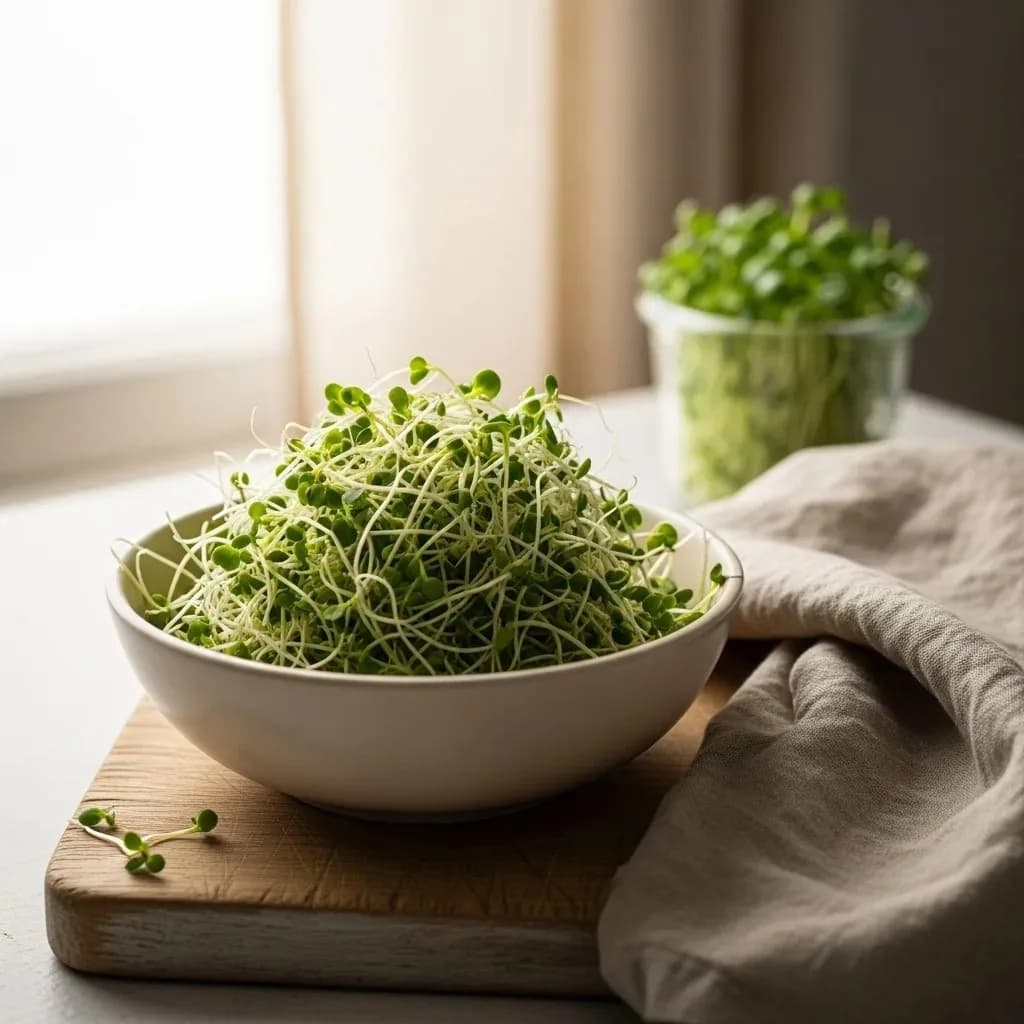
What Is Sulforaphane and Why Does It Come From Sprouts?
Quick Answer
Broccoli sprouts are 3-day-old seedlings with 20-50x more glucoraphanin than mature broccoli. (Talalay et al., PNAS 1997.) Glucoraphanin is the precursor your body converts into sulforaphane, a compound linked to reduced inflammation, better blood sugar control, and cancer-protective pathways. About 30g daily is the amount most studies use.
Sulforaphane does not exist pre-formed in broccoli. The plant stores glucoraphanin in one cellular compartment and myrosinase enzyme in another. When you chop or chew the plant, those compartments mix and myrosinase converts glucoraphanin into sulforaphane on the spot.
The reason 3-day sprouts deliver 20-50x more sulforaphane potential than mature broccoli is about the plant's stage of life. At the seedling stage, the plant has its highest concentration of glucoraphanin per gram of mass. Researchers at Johns Hopkins confirmed this in 1997. Paul Talalay, Jed Fahey, and Yuesheng Zhang published their findings in the Proceedings of the National Academy of Sciences. (Talalay, Fahey & Zhang, PNAS 1997, doi:10.1073/pnas.94.19.10367.) The New York Times covered it. Broccoli seed prices spiked. For a brief period there was a global seed shortage. That is how significant the finding was.
One practical consequence: heat broccoli sprouts above 70°C and you destroy myrosinase. Sulforaphane production stops. This is why sprouts are eaten raw. If you are cooking mature broccoli, chop it first and wait 40 minutes before applying heat. The myrosinase finishes its work before the heat shuts it down.
At 3 days old, a broccoli seedling is at peak chemical defense mode. The plant concentrates glucoraphanin precisely because it is most vulnerable at this stage. As it matures into a full vegetable, those compounds dilute across a much larger plant mass.
What Does the Research Actually Show?
The studies are more specific than most articles admit.
Inflammation: A 2018 study published in Clinical Nutrition gave 40 overweight adults 30g of broccoli sprouts daily for 10 weeks. IL-6, a key inflammation marker, dropped from 4.76 to 2.11 pg/mL. That is a 56% reduction from real sprouts, not supplements. (Clinical Nutrition, 2018; ISSN 0261-5614.)
Blood sugar: A 2012 randomized controlled trial enrolled 81 people with type 2 diabetes. They took 10g per day of broccoli sprout powder for 4 weeks. Fasting glucose fell by 1.9 mmol/L and hs-CRP dropped 20.5%. (Bahadoran et al., European Journal of Clinical Nutrition, 2012.)
Cancer: The language has to stay careful here. Research suggests sulforaphane activates the Nrf2/Keap1 pathway, upregulating detoxification enzymes that may help neutralize carcinogens before they damage DNA. (MD Anderson Cancer Center; Ali et al., Frontiers in Oncology, 2023.) A 2015 Phase II trial at OHSU Knight Cancer Institute gave concentrated sulforaphane extract to 20 men with recurrent prostate cancer. PSA doubling time extended from 6.1 to 9.6 months (p=0.044). (Alumkal et al., Investigational New Drugs, 2015.) Research suggests. Not cures.
For readers who want to go deeper: Rhonda Patrick's sulforaphane video on FoundMyFitness covers traumatic brain injury research, neurodegeneration, and aging mechanisms. It is 47 minutes and worth every one of them.
Are Sulforaphane Supplements as Good as Broccoli Sprouts?
Mostly no. During processing, most supplements remove the myrosinase enzyme. Without it, glucoraphanin conversion to sulforaphane is inconsistent. You may be getting far less than the label suggests.
The exception: supplements labeled "myrosinase-active" that add the enzyme back. Those perform better. But fresh sprouts still have the edge because the glucoraphanin and myrosinase are in their intact, natural form.
If the choice is a standard capsule versus a handful of sprouts on a sandwich, the sprouts win. Honestly.
Without myrosinase, glucoraphanin conversion in most capsule supplements is inconsistent. Fresh sprouts deliver both compounds in intact, natural form.
How Much Broccoli Sprouts Should You Eat?
Most studies use 30g per day, about one small handful. That was the dose in the 2018 inflammation trial. (Clinical Nutrition, 2018.) The 2012 diabetes study used 10g of dried powder, smaller but more concentrated. (Bahadoran et al., 2012.)
Start small if you are new. The isothiocyanate compounds can cause temporary gas until your gut adjusts. I started with a spoonful on avocado toast. Within a week I was adding them to everything.
Daily is fine. The 2018 study ran 10 weeks at 30g/day with no adverse effects reported.
Can You Grow Broccoli Sprouts at Home?
Yes, and none of the top results in Google actually explains this. I started growing them in a mason jar on the kitchen counter. Adam now thinks they are a science experiment. This has helped with his willingness to eat them enormously.
The method: soak a tablespoon of sprouting-grade broccoli seeds for 8 hours. Drain into a wide-mouth mason jar with a mesh lid or cheesecloth. Tilt the jar so water drains and air circulates. Rinse twice a day. By day 3 you have sprouts. No soil. No sun. Just a jar.
We now run a constant rotation. One jar started every 3 days means we always have fresh ones in the kitchen.
Look for broccoli seeds labeled specifically for sprouting, organic and untreated. Standard garden seeds may be treated with fungicide. Sprouting-specific seeds are widely available online for around $8-12 per 4oz bag, which grows dozens of batches.
Are There Any Side Effects?
For most people, none significant. Temporary gas at the start is real but passes within a week. If you take thyroid medication, check with your doctor. Large amounts of cruciferous vegetables can interfere with thyroid hormone synthesis. A handful a day is unlikely to be an issue, but it is worth knowing.
High-dose sulforaphane extracts have been studied at up to 200 micromoles per day in clinical settings without serious adverse events. (Alumkal et al., Investigational New Drugs, 2015.) The dose from whole sprouts is well within that range.
References
- Talalay, P., Fahey, J. W., & Zhang, Y. (1997). Broccoli sprouts as inducers of carcinogen-detoxifying enzyme systems. Proceedings of the National Academy of Sciences, 94(19), 10367-10372. doi:10.1073/pnas.94.19.10367
- Bahadoran, Z., et al. (2012). Broccoli sprouts reduce oxidative stress in type 2 diabetes. European Journal of Clinical Nutrition, 66(8), 972-977. doi:10.1016/j.nut.2012.02.009
- Alumkal, J. J., et al. (2015). Sulforaphane decreases PSA doubling time in men with recurrent prostate cancer. Investigational New Drugs, 33(3), 755-764. doi:10.1007/s10637-014-0189-z
- Ali, M. A., et al. (2023). Anticancer properties of sulforaphane: current insights at the molecular level. Frontiers in Oncology, 13, 1168321. doi:10.3389/fonc.2023.1168321
- USDA FoodData Central (2019). Broccoli, raw. FDC ID 170379. fdc.nal.usda.gov


