
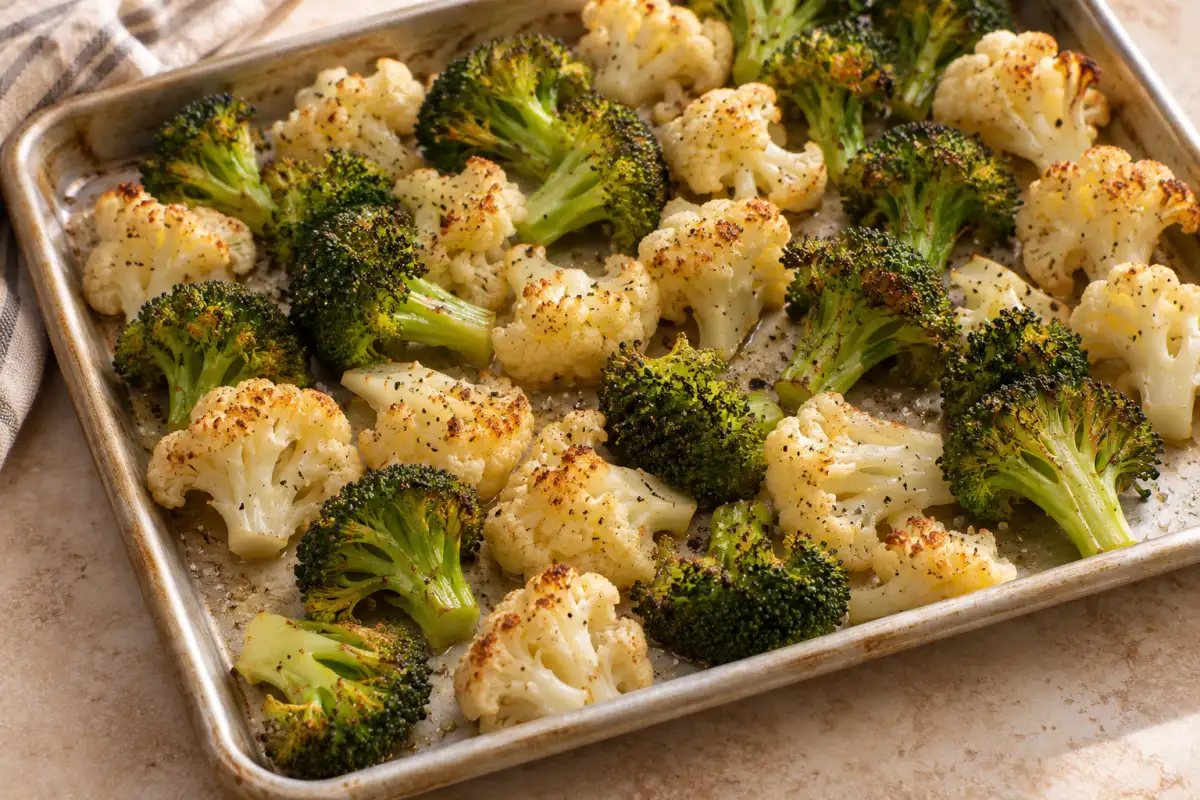
A tray with dark broccoli tips and hard cauliflower middles needs a better plan, not another handful of seasoning. Both vegetables belong in the oven together, but their cuts need different attention. Keep the cauliflower compact, split thick stems, and give every piece some breathing room.
What goes on the tray?
This plain version leaves room for whatever else is for dinner. It has no cheese, garlic or hidden sauce. The broccoli brings branching florets; cauliflower adds denser pieces that need careful trimming. A modest oil coating should reach the crevices without leaving a puddle beneath the vegetables.
For four side portions, measure:
- 12 ounces (340 g) trimmed broccoli florets and peeled stem pieces
- 12 ounces (340 g) trimmed cauliflower florets
- 2 tablespoons (30 ml) olive oil
- ½ teaspoon fine salt
- ¼ teaspoon ground black pepper
The weights are after trimming. Buying two whole heads will usually leave extra vegetables, so weigh the prepared pieces rather than guessing from head size. Keep the remaining cauliflower for another meal and follow the broccoli storage guide for the broccoli.
How should the pieces be cut?
Start with clean produce. The FDA's produce guidance recommends running water rather than soap. Pat the washed vegetables dry before adding oil.
Cut broccoli crowns into pieces roughly 1½ inches across. Slice the thickest branches lengthwise so they have a flat surface. Peel the woody outside from usable broccoli stalks, then cut the tender inside into thin pieces. The floret-cutting guide shows how to separate the branching sections without shredding the crown.
Aim for cauliflower florets around 1 inch across, with thick stems split. The two vegetables can still finish at different times, even with similar cuts. If your cauliflower has unusually dense stems, make those pieces thinner instead of cutting the delicate broccoli tops smaller and smaller.
One-tray roasting method
Makes approximately four side portions. Equipment: one bare, light-colored rimmed half-sheet pan, approximately 18 by 13 inches, a mixing bowl, tongs and oven gloves. Allow about 15 minutes for preparation and 20–25 minutes for roasting.
- Heat the oven to 425°F (220°C) with a rack in the middle. Leave the sheet pan at room temperature until you have arranged the vegetables, so handling stays straightforward.
- Put the dry broccoli and cauliflower in the bowl. Add oil, salt and pepper. Toss with clean hands or utensils until both vegetables have a thin coating.
- Spread the pieces across the sheet pan. Set some flat surfaces against the metal. If pieces overlap or form a deep heap, divide the batch between two pans rather than forcing it onto one.
- Roast for 12 minutes, then turn the pieces with tongs. Rotate the tray if one side is coloring faster. Keep your face away from the oven opening as hot air escapes.
- Start checking at 18 minutes. Pierce a thick cauliflower stem and a broccoli branch. Continue in short intervals until both are as tender as you like, with browned edges rather than black, brittle tops.
- Remove individual pieces that finish early to a clean serving dish. Let any firmer pieces continue. Taste a cooled bite before deciding whether extra salt is needed.
Use a separate forkful from each vegetable when checking. A soft broccoli top cannot tell you whether the cauliflower stem is ready. The fork check matters more than the clock. The separate roasting guide covers broccoli on its own; this page adds the cauliflower size and staging decisions.
What if one vegetable finishes first?
Lift the finished pieces out. There is no prize for making broccoli wait while cauliflower catches up. On the next batch, split the cauliflower stems thinner or start those larger pieces first. Make the change to the cauliflower cuts rather than extending the broccoli’s time over and over.
If both vegetables remain pale, look at spacing and surface moisture. Turn a few pieces over: a damp underside and crowded tray suggest the vegetables need more room. Spread them across another pan and keep checking. Do not add extra oil simply because the tops are pale.
If the tips darken before the stems soften, reduce the oven to 400°F and check more frequently. Very small broccoli crumbs can burn while the larger florets still need time. Sweep those loose crumbs off the cutting board before transferring the main pieces.
Can you change the batch?
For two side portions, halve every ingredient and use a smaller rimmed metal tray that still allows a single layer. Keep the first check early: less food does not mean that every piece will cook in half the time.
For eight portions, use two sheet pans and double the ingredients. Switch the pans between racks and rotate them when turning the vegetables. Crowding one tray changes the result more than doubling the seasoning does. Check both pans separately, since the upper tray may brown faster.
Frozen vegetables are a different starting point because surface ice and piece size vary. This method uses fresh produce. Use the frozen broccoli guide for that workflow rather than thawing a bag and assuming it will behave exactly like these dry florets.
Serving and leftovers
Serve alongside rice, lentils, fish or another main dish. Keep the vegetables uncovered briefly while plating so they are not sitting in trapped steam. Add a sauce at the table if wanted, but the plain batch pictured uses only the listed ingredients.
Move leftovers into shallow containers promptly. FoodSafety.gov advises refrigeration within two hours, reduced to one hour above 90°F (32°C). Do not leave the tray out through a long evening. To reheat, spread the vegetables on a tray or warm them in a skillet, turning occasionally. They will usually be softer than when first roasted.
Reheat leftovers to 165°F (74°C), checking with a food thermometer.
How should you plate the roasted vegetables?
When serving with a saucy main dish, put the vegetables beside it rather than underneath. That keeps some browned edges exposed instead of soaking the whole portion. A spoonful of plain rice or a piece of bread can handle the sauce without turning the broccoli soft.
Questions before you cook
Do broccoli and cauliflower need identical cuts?
No. Match the amount of thick stem inside each piece rather than forcing both crowns into the same outline. Slightly smaller cauliflower pieces are the starting point here.
Do you need to boil them first?
Not for this fresh-vegetable method. Adding a blanching step would introduce moisture and change the timing. For softer vegetables, keep roasting over a gentler heat until the stems yield easily to a fork.
Can you use parchment?
This version specifies bare metal. Parchment changes surface contact and must be rated by its manufacturer for the oven temperature. Expect the undersides to brown differently and check them when you turn the vegetables.
References
- U.S. Food and Drug Administration. (n.d.). Selecting and serving produce safely. Retrieved November 4, 2026.
- FoodSafety.gov. (2023). 4 steps to food safety. Retrieved November 4, 2026.