
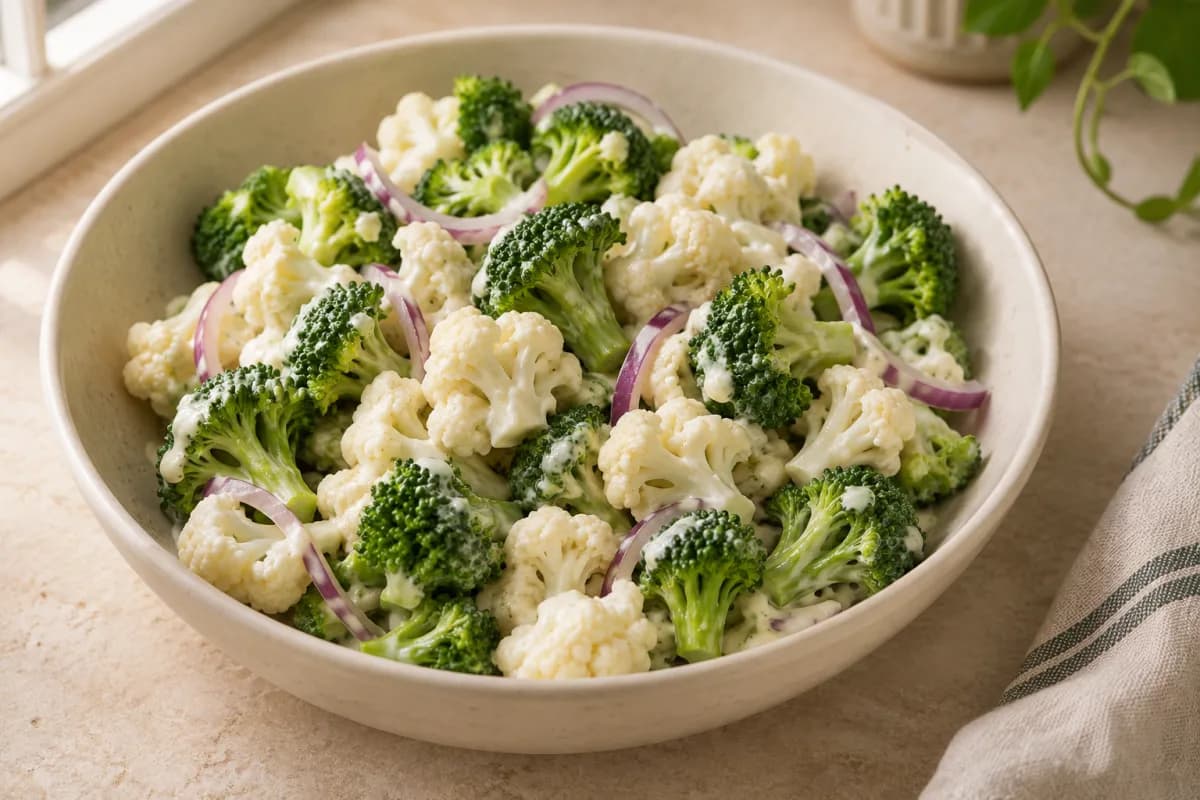
A bowl of chunky salad should be easy to eat with a fork. That is the starting point here: broccoli and cauliflower cut small enough to share a bite, a little red onion, and a creamy dressing that coats the vegetables without burying them.
Add the creamy vinegar-mustard dressing gradually. Broccoli branches catch it differently from rounded cauliflower pieces, so toss from underneath and check the coating.
What ingredients do you need?
Choose firm vegetables without slimy or rotten areas. A full head gives more control over floret size than a bag of oversized pieces. You can use prepared florets, but weigh them after removing any pieces you do not intend to serve.
For approximately six side portions, set out:
- 300 g broccoli florets, trimmed
- 300 g cauliflower florets, trimmed
- 30 g red onion, sliced into very thin, short strips
- 70 g commercial mayonnaise
- 60 g plain unsweetened yogurt
- 20 ml apple cider vinegar
- 8 g Dijon mustard
- 8 g granulated sugar
- 2 g fine salt
- A small pinch of ground black pepper
Allow about 30 minutes to prepare and 20 minutes to rest in the refrigerator. Use a large bowl, small bowl, whisk, board, knife, scales and clean salad servers.
The dressing contains milk and commonly egg; check the mayonnaise and mustard labels for allergens. Bacon, cheese, fruit and nuts are not part of this version. The onion adds a little bite to the mild vegetables.
How small should the florets be?
Aim for pieces around 1.5 cm across, with stalks sliced thin enough to sit comfortably on a fork. The pieces need not be perfect cubes; the vegetables have different shapes.
Cut a large branch through its stem, then separate it into smaller pieces. Repeatedly chopping straight through the tops can produce a pile of crumbs. Some small fragments are fine, but save an excessive amount for cooking rather than letting them dominate the salad.
The FDA's produce guidance supports washing under running water, not with soap. Dry the vegetables well. Keep the raw salad preparation away from boards and tools used for raw meat.
Our broccoli floret cutting guide explains the branching structure. For this salad, continue dividing those pieces until they are smaller than you would usually prepare for roasting. Check one piece of each vegetable before committing the whole batch.
How do you make the salad?
- Prepare, wash and dry the vegetables. Weigh the usable broccoli and cauliflower, then cut them into small florets. Slice the onion into thin, short strips so there are no large, sharp-tasting pieces.
- Whisk the mayonnaise, yogurt, vinegar, mustard, sugar, salt and pepper in the small bowl. Scrape the sides and mix until the dressing is uniform.
- Put the broccoli, cauliflower and onion in the large bowl. Turn them together with clean servers so the onion is spread through the mixture.
- Add three quarters of the dressing. Toss gently from underneath, lifting the vegetables through it. Check the bottom of the bowl before deciding whether to add the rest.
- Cover and refrigerate for about 20 minutes. Stir again and taste a combined forkful, checking whether either vegetable feels too large or hard.
- Divide into approximately six side portions. Use a clean spoon to take salad from the bowl, keeping the remainder chilled until it is needed.
The goal is a thin, even coating. A little dressing caught in the broccoli tips is expected. Large white puddles around the cauliflower are a reason to reassess the amount, not an invitation to keep pouring.
Should the vegetables be raw or blanched?
This recipe uses raw vegetables for a crisp bite. Smaller florets are especially useful here: a thick cauliflower stem can be awkward even when the delicate top looks ready to eat. Trim a thick base thinner rather than cutting the entire floret into crumbs.
If you prefer cooked vegetables, steam the broccoli and cauliflower separately until they reach the tenderness you like. Cool promptly, drain thoroughly and chill before dressing. Moisture caught in cooked florets can dilute the coating, so add the dressing gradually and toss gently to avoid breaking them.
For a warm vegetable side instead, use our steamed broccoli guide. For a different raw broccoli recipe with larger supporting ingredients, see classic broccoli salad. Choose the preparation that suits the rest of the meal.
What can go wrong with the dressing?
| What you notice | Likely question to check | Next adjustment |
|---|---|---|
| Watery dressing | Were florets wet when dressed? | Drain excess liquid for serving; dry future batches thoroughly. |
| Dressing in clumps | Was the yogurt fully whisked? | Mix the dressing separately before it touches the vegetables. |
| Harsh onion flavour | Are the pieces too large? | Use thinner strips or reduce the amount of onion. |
| Flat flavour | Is the whole bite underseasoned? | Add tiny measured amounts of vinegar or salt, tasting between changes. |
Adjust one thing at a time. If the dressing tastes flat, try a few drops of vinegar before adding more salt. If it is too sharp, a small spoonful of mayonnaise or yogurt softens the coating. Toss thoroughly before tasting again so one concentrated patch does not mislead you.
How should you chill and serve it?
You can prepare the vegetables and dressing separately, cover them and keep them refrigerated until mixing. This gives more control over moisture than dressing everything far in advance. Dress a smaller portion first if you are preparing a large bowl for several meals, and keep the remaining components covered and cold.
Follow FoodSafety.gov's refrigeration guidance: chill perishables within two hours, or within one hour when temperatures exceed 90°F. Keep the refrigerator at 40°F or below. Use clean utensils when taking out portions.
Serve a small bowl at a time for a gathering, keeping the rest chilled. Do not add fresh salad to an older bowl that has been sitting out. For the vegetables before preparation, our broccoli storage guide covers handling and signs that a head should be discarded.
Broccoli cauliflower salad questions
Can you use only one vegetable?
Yes. Keep the total vegetable weight at 600 g and add the dressing gradually. An all-broccoli bowl can catch more dressing in its branches, while cauliflower pieces may leave more coating at the bottom. Toss from underneath rather than pouring in extra dressing straight away.
Can you add bacon or nuts?
Yes. Add fully cooked, cooled bacon or a small handful of chopped nuts just before serving. Check allergies first, and keep the salad refrigerated. Introduce a little at a time so the extras do not overwhelm the vegetables.
What goes well with this salad?
Serve it with a sandwich, baked potato, grilled fish or a simple main dish. It already brings a creamy, tangy element, so keep other sauces alongside rather than mixing them into the bowl. A small portion is also useful beside rice or a warm grain dish.
References
U.S. Food and Drug Administration. (n.d.). Selecting and serving produce safely. Retrieved November 4, 2026, from https://www.fda.gov/food/buy-store-serve-safe-food/selecting-and-serving-produce-safely
FoodSafety.gov. (2023, September 18). 4 steps to food safety. https://www.foodsafety.gov/keep-food-safe/4-steps-to-food-safety