Chinese Broccoli (Gai Lan): How to Cook It Right
By Elena Ignacio · Updated June 2024
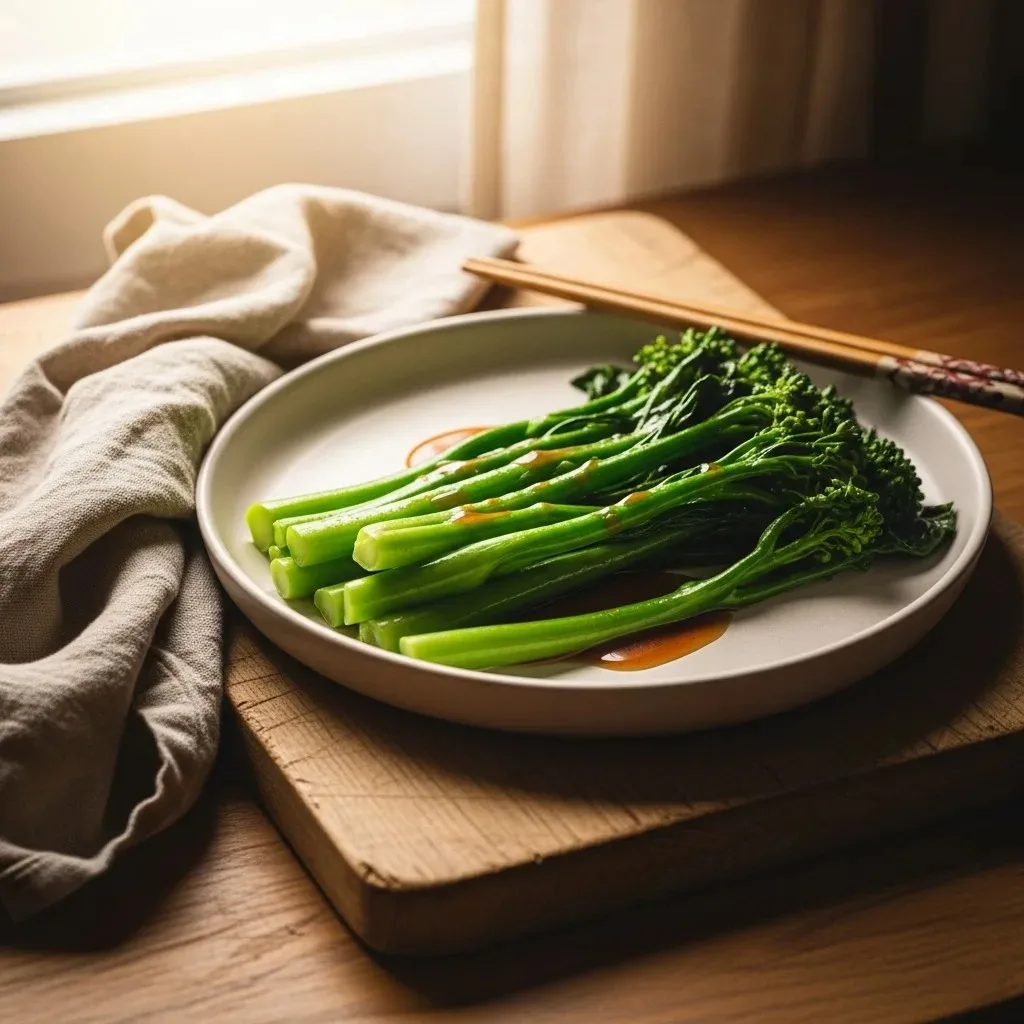
Adam told me gai lan and broccoli weren't the same thing. He was seven. He was right.
He had been eating gai lan at his school canteen in Singapore since 2021, stir-fried with oyster sauce pooling at the plate edge. He came home one evening and asked why we never had it. I said we had broccoli. He looked at me with complete seven-year-old certainty and said, “That’s not the same thing.” I spent the next two weeks discovering he was right. Part of that time I served gai lan slightly yellow to Alfi, who pushed it to the side of his plate without a word.
Here is what I learned.
Quick Answer
Gai lan (Chinese broccoli) is a dark green brassica with thick crunchy stems, flat leaves, and small white flower buds. It tastes mildly bitter and peppery. Blanch in salted oily water for 1 to 2 minutes, stems first, leaves last 30 seconds, then pour a cornstarch-thickened oyster sauce over the top.
What's the difference between gai lan, regular broccoli, and broccolini?
Regular broccoli grows a large central head. Gai lan has almost none of that. It is a long stem with flat dark leaves and tiny buds at the top. The bitterness is different too: regular broccoli is mild and nutty; gai lan sits closer to broccoli rabe but gentler.
Broccolini is a hybrid of gai lan and regular broccoli, developed in Japan in the 1990s. Those long-stemmed bunches that cost more than you expect at the supermarket? That is broccolini. It looks like gai lan but tastes milder and sweeter. Not the same vegetable.
| Gai Lan | Regular Broccoli | Broccolini | |
|---|---|---|---|
| Main part | Stems + leaves | Florets | Stems + small florets |
| Flavour | Mildly bitter | Mild, nutty | Mild, slightly sweet |
| Blanch time | 1 to 2 min | 3 to 5 min | 1.5 to 2 min |
How do I pick good gai lan at the supermarket?
Dark blue-green leaves. No yellowing. Tight, compact buds at the top. If the buds have opened into white or yellow flowers, the bunch is past its peak and will taste more bitter.
Thinner stems mean younger gai lan, which is more tender. Baby gai lan, sold at some Singapore supermarkets, is the most delicate. Avoid bunches with limp leaves or dry-looking cut ends.
What does gai lan taste like?
Slightly bitter, mildly peppery, clean. Not as sharp as broccoli rabe. Not as neutral as bok choy. Cooking softens the bitterness. The stems turn sweet and almost buttery when blanched properly. The leaves wilt into something silky.
What's the best way to cook gai lan?
Two methods. Blanching is the classic dim sum approach. Stir-frying gives more flavour from garlic and sauce. I do both.
Blanching (faster, closer to restaurant style)
Use more water than you think. Add 1 teaspoon salt and 1 tablespoon neutral oil before it boils. The oil is not for flavour. It coats the leaves and stops them from oxidising. This is why restaurant gai lan stays bright green and home-cooked gai lan goes dull.
Separate the thick stems from the leaves. Add stems first (1.5 to 2 minutes), then leaves (30 to 45 seconds). Lift out the moment the stems turn bright green and just yield to a knife. Not soft. Plate immediately.
Stir-fry (more flavour, better for cut pieces)
Slice the stems on a diagonal. This is not optional. A bias cut increases surface area and helps them cook evenly and fast. Separate stems and leaves before you start.
Heat the wok until it smokes. Oil. Stems first, 60 to 90 seconds. Add garlic. Add leaves, 30 seconds. Add sauce, toss. Off heat, add sesame oil. If you add sesame oil while the wok is hot, the aroma burns off entirely.
The sauce that actually clings
Mix 3 tablespoons oyster sauce, 1 teaspoon soy sauce, 1 teaspoon sugar, 2 tablespoons water, and 1 teaspoon cornstarch. The cornstarch makes the sauce coat the stems instead of sliding off. Skip it and the sauce pools at the bottom. This is the most useful thing I learned.
How long does gai lan take to cook?
| Baby gai lan | Standard | Mature / thick | |
|---|---|---|---|
| Blanching stems | 45 sec | 1.5 min | 2 min |
| Blanching leaves | 20 sec | 30 sec | 45 sec |
| Stir-fry stems | 45 sec | 60 to 90 sec | 2 min |
The moment gai lan turns yellow, it is overcooked. Stems should be bright green and tender but not soft. Leaves wilted but not collapsed.
Is gai lan healthy?
Yes, practically.
Gai lan is cruciferous, like broccoli, cabbage, and bok choy. Cruciferous vegetables contain glucosinolates that convert to sulforaphane when you chop or chew them. Research suggests these compounds may support cellular health, though the evidence is for whole vegetable consumption over time, not a single serving (MD Anderson Cancer Center, “Cruciferous Vegetables and Cancer Prevention”).
The calcium surprised me. Gai lan provides around 105 mg calcium per 100g vs 47 mg in regular broccoli (USDA FDC comparison). More than twice the calcium. For two boys who don't drink much milk, that landed. Vitamin C is around 45 mg per 100g (USDA FDC).
One practical note: chopping gai lan and waiting a few minutes before cooking activates the myrosinase enzyme, increasing sulforaphane production. Heat above 70°C slows this enzyme, so a brief blanch preserves more activity than long boiling (Bhupathiraju & Tucker, Clin Chim Acta, 2011; PubMed 2020). Cut it, wait a few minutes, cook it fast.
How do I store gai lan and what can I substitute?
Wrap in a damp paper towel, store in an open bag in the crisper. Stays good for 3 to 4 days. Wash right before cooking, not before storing.
When gai lan is not available: broccolini is the closest substitute in flavour and structure. Choy sum works for the blanch-and-oyster-sauce method. Bok choy is a fallback but has a different texture and more water content.
FAQs
What is gai lan?
Gai lan is Chinese broccoli, a dark green brassica with thick crunchy stems, flat leaves, and small white flower buds. The Cantonese name; also called kailan in Malay and kai-lan in Thai.
Is gai lan the same as broccolini?
No. Broccolini is a hybrid of regular broccoli and gai lan. They share long stems but gai lan has flatter, darker leaves and more bitterness. Broccolini tastes milder.
How long does gai lan take to cook?
Blanching: 1 to 2 minutes for stems, 30 to 45 seconds for leaves added separately. Baby gai lan: 45 seconds. Stir-frying: 60 to 90 seconds for stems plus 30 seconds for leaves. Overcooked gai lan turns yellow and limp.
Can you eat gai lan leaves?
Yes. Add them last, 30 seconds. They wilt silky and absorb the sauce well. They cook much faster than the stems, which is why you separate them before starting.
Sources
- USDA FDC: calcium content comparison, gai lan vs standard broccoli (FDC ID 170379 for regular broccoli)
- MD Anderson Cancer Center: “Cruciferous Vegetables and Cancer Prevention” — glucosinolates overview
- Bhupathiraju SN, Tucker KL. Coronary heart disease prevention: nutrients, foods, and dietary patterns. Clin Chim Acta. 2011 — sulforaphane and myrosinase activation
- PubMed (2020): myrosinase enzyme activity and heat deactivation in cruciferous vegetables