Types of Broccoli: What’s Actually in the Market and How They Taste

Adam has eaten gai lan at his school canteen for two years straight. I watched him finish every last stalk. I assumed it was a different cut of regular broccoli, the kind I steam at home. So one Saturday at the wet market I grabbed a fat bunch of it, went home, steamed it exactly like Calabrese florets, and ruined the whole thing. Bitter, slightly slimy, nothing like what the school was serving. I called my mum in Manila. She laughed and explained the oyster sauce and high-heat wok trick. That was the moment I realised the broccoli family is a lot bigger and stranger than any supermarket makes it look.
How many types of broccoli are there?
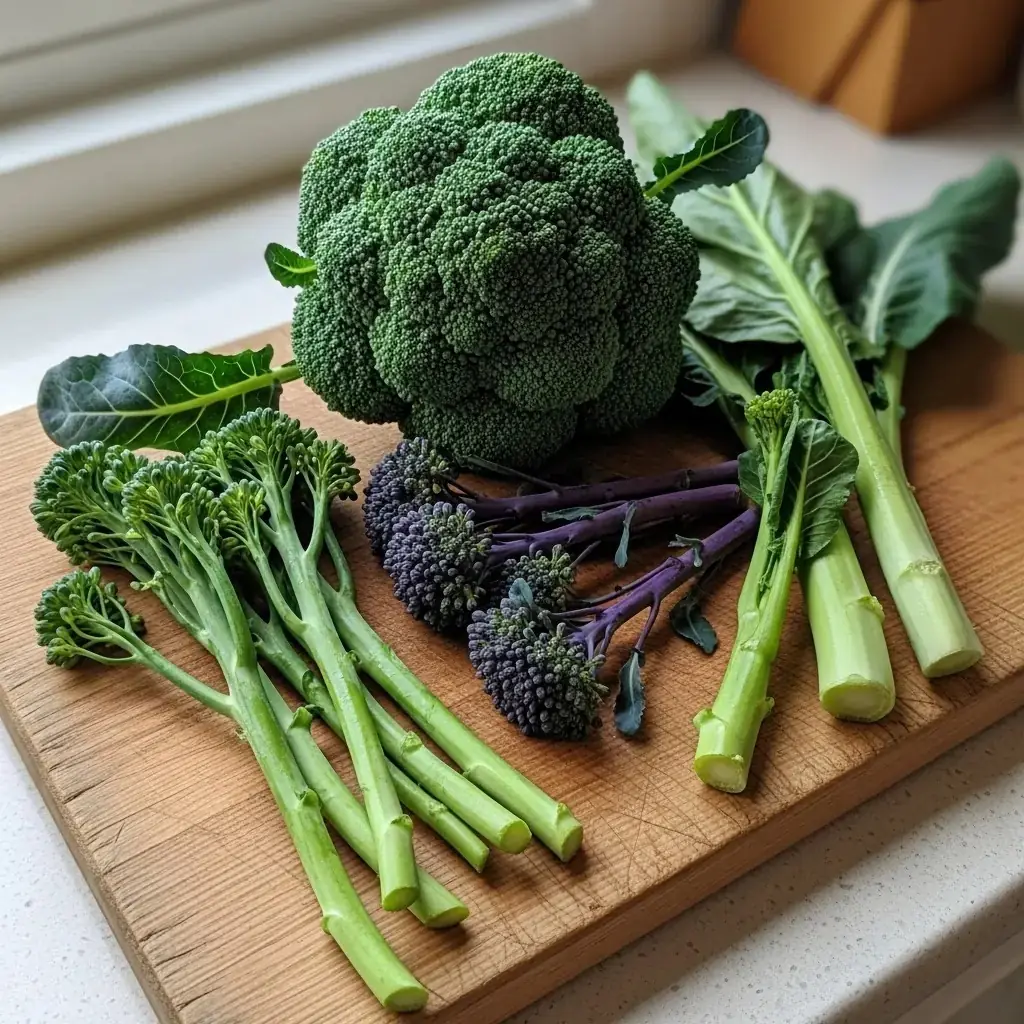
Six main types appear consistently in markets and cooking. Calabrese is the one most people grow up eating. Then there’s broccolini, purple sprouting, Chinese broccoli, broccoli rabe, and Romanesco. Beyond those six, seed companies sell dozens of named Calabrese cultivars like Belstar and Di Cicco, but those are varieties within the same type, not separate categories.
All six belong to Brassica oleracea, the same species that gave us cabbage, kale, and Brussels sprouts.
What is Calabrese broccoli and why is it everywhere?
Calabrese is what you find in every supermarket. Named after Calabria in southern Italy, it has that familiar large dome-shaped head, thick central stalk, and dark green florets. Italians brought it to the United States in the early 1900s.
Per 100g raw, Calabrese delivers 89.2 mg of vitamin C (99% of daily value), 102 mcg of vitamin K, 2.82g of protein, and 2.6g of fiber. (USDA FDC 170379) I never throw away the stalk. I peel the tough outer layer and slice it into whatever I’m cooking. It has more fiber than the crown.
One practical thing worth knowing: sulforaphane, the compound broccoli is nutritionally known for, is only produced when the vegetable is chopped. Chopping activates myrosinase, which converts glucoraphanin into sulforaphane. Boiling destroys that enzyme. Steaming and stir-frying preserve it better. (USDA FDC 170379) This applies to every broccoli type, not just Calabrese.
What is the difference between broccolini and regular broccoli?
Broccolini looks like broccoli’s thinner, more elegant cousin. Long slim stems, small loose florets, sweet flavour with none of the bitterness. The entire plant is edible. No peeling.
It was engineered over eight years by Sakata Seed Company in Japan, crossing regular broccoli with gai lan. Not genetically modified. Conventional hybrid breeding. It hit grocery shelves in the US in 1996. (Wikipedia: Broccolini) Alfi eats broccolini raw from the bag, which he refuses to do with regular broccoli, so I buy it for snacks more than anything else.
What is Chinese broccoli and where do you find it?
Chinese broccoli, or gai lan in Cantonese, is Brassica oleracea var. alboglabra. Thick flat glossy leaves, small white flowers, and a flavour that’s stronger and slightly more bitter than Calabrese. At any wet market in Singapore it’s available fresh year-round.
The bitterness comes from glucosinolates. High heat and a bit of fat (oil, oyster sauce) round it out. Steaming it low and slow, the way I made my mistake with Adam’s canteen gai lan, concentrates the bitterness rather than softening it. Stir-fry it on the highest heat your stove can manage, with garlic and oyster sauce, and we get that same canteen result Adam loves.
Nutritionally, the big leaves give gai lan more vitamin A per serving than Calabrese. It’s also a solid source of calcium, vitamin C, and folate.
Does purple sprouting broccoli stay purple when you cook it?
No. Purple sprouting broccoli turns green when you cook it. The purple colour comes from anthocyanins, the same pigments that make blueberries blue and red cabbage red. Anthocyanins are water-soluble and heat-sensitive. They break down within a couple of minutes of cooking.
The flavour is sweeter and more tender than Calabrese. Research published in Oxford Academic Bioscience Horizons (2012) found higher antioxidant activity in purple sprouting compared to green Calabrese, likely due to the anthocyanin content. (Bioscience Horizons, Oxford Academic, 2012) If you want to keep the colour, eat it raw. It’s mild enough for that.
What is the fancy green broccoli with the spiral pattern called?
Romanesco. Each cone on the head is made of smaller cones, which are made of even smaller ones. The number of spirals on a Romanesco head is always a Fibonacci number. Research from 2021 linked that fractal geometry to disruptions in floral gene networks during development.
Here’s what most articles get wrong: Romanesco is technically a cauliflower cultivar, not a broccoli-cauliflower hybrid. Its classification is Brassica oleracea var. botrytis, same as white cauliflower. (Wikipedia: Romanesco broccoli) The flavour reflects that. Nutty, mild, firmer in texture. Roasting at 220°C until the tips just char is the best way I’ve found to cook it.
Is broccoli rabe actually broccoli?
No. Broccoli rabe, also called rapini, belongs to Brassica rapa, the same family as turnips. Not closely related to broccoli. The name is misleading.
The taste is significantly more bitter and peppery than anything else in this list. A quick blanch before sauteing reduces the bitterness. Sixty seconds in boiling water, then straight into a hot pan with garlic and chilli oil. Italian cooking uses it in pasta and with sausage for a reason. You need strong flavours to stand up against it.
Frequently Asked Questions
How many types of broccoli are there?
Six main types: Calabrese, broccolini, gai lan (Chinese broccoli), purple sprouting broccoli, broccoli rabe (rapini), and Romanesco. Seed catalogues list dozens of cultivar names within Calabrese, but those are varieties of the same type, not separate categories.
What is the fancy green broccoli with the spiral pattern called?
Romanesco. It is technically a cauliflower cultivar (Brassica oleracea var. botrytis). The spiral cones follow Fibonacci numbers, a pattern linked to disruptions in floral gene networks. It tastes nutty and mild. Roasting is the best method.
Is broccoli rabe actually broccoli?
No. Broccoli rabe (rapini) is Brassica rapa, the same family as turnips, not broccoli. It is much more bitter. Blanching for 60 seconds before cooking reduces the bitterness significantly.
Does purple sprouting broccoli stay purple when you cook it?
No. The purple colour from anthocyanins breaks down with heat. The broccoli turns green within minutes of cooking. Eat it raw to keep the colour.
What is the difference between broccolini and regular broccoli?
Broccolini is a hybrid of broccoli and Chinese broccoli developed by Sakata Seed Company in Japan. It has thinner stems, smaller florets, a sweeter flavour, and no bitterness. The entire plant is edible. It is not genetically modified.
Sources
- USDA FoodData Central FDC ID 170379 — Broccoli, raw. fdc.nal.usda.gov
- Wikipedia: Broccolini. en.wikipedia.org/wiki/Broccolini
- Wikipedia: Romanesco broccoli. en.wikipedia.org/wiki/Romanesco_broccoli
- Wikipedia: Gai lan. en.wikipedia.org/wiki/Gai_lan
- Oxford Academic Bioscience Horizons (2012) — antioxidant properties of purple sprouting vs green Calabrese broccoli.