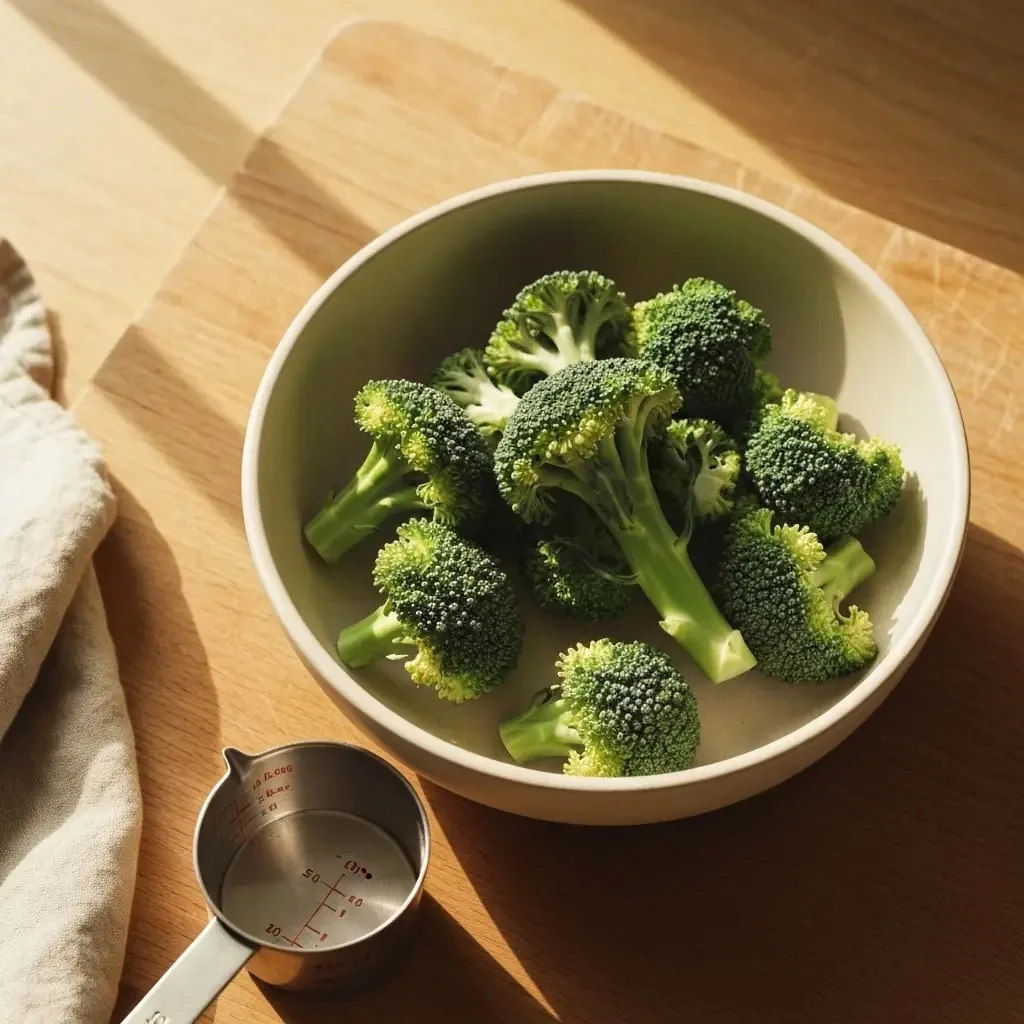
Broccoli Calories Per Cup: Raw, Steamed, Boiled
Updated June 16, 2026
In Osaka in 2022, I weighed what I thought was a big bowl of steamed broccoli. MyFitnessPal said 38 calories. I weighed it again because I didn't believe it. Adam was sitting next to me at the table going through his "nothing green" phase and I almost said out loud: "You have no idea what you're missing." That number changed how I cook. Broccoli became the vegetable I stopped worrying about.
Quick Answer
One cup of raw broccoli (91g) contains 31 calories, 6g of carbohydrates, 2.6g of fibre, and 2.6g of protein. (USDA FDC 170379) Cooked broccoli, boiled and drained, drops to around 27 calories per cup because the florets absorb water and become denser by weight.
How many calories are in 1 cup of raw broccoli?
One cup of raw, chopped broccoli weighs 91g and contains 31 calories. (USDA FDC 170379)
| Nutrient | Amount |
|---|---|
| Calories | 31 kcal |
| Protein | 2.57g |
| Carbohydrates | 6.04g |
| Dietary Fiber | 2.37g |
| Net Carbs | ~3.7g |
| Fat | 0.34g |
| Vitamin C | 81.2mg (90% DV) |
| Vitamin K | 92.8mcg (77% DV) |
| Folate | 57mcg |
| Potassium | 288mg |
The reason this feels almost too low: broccoli is roughly 89% water by weight. Water has no calories. So you're eating something that is mostly liquid, wrapped in fibre, protein, and vitamins. The calorie cost is nearly nothing.
Does cooking broccoli change the calorie count?
The calories barely change. What changes is the weight of one cup. Raw broccoli is 91g per cup. Boiled and drained: 156g per cup. The florets compact, absorb water, and take up less space. So when you measure by cup, you are eating more grams of cooked broccoli than raw. That is why the numbers per cup look different.
| Preparation | Weight per cup | Calories |
|---|---|---|
| Raw, chopped | 91g | 31 kcal |
| Steamed | ~95g | ~33 kcal |
| Boiled, drained | 156g | 27 kcal |
| Roasted (no oil) | ~90g | ~35 kcal |
| Roasted (1 tsp oil) | ~90g | ~75 kcal |
Roasting is the exception. The broccoli itself barely changes in calories. The oil you add does. One teaspoon of olive oil adds roughly 40 calories. That is the variable to track, not the broccoli.
I steam almost everything at home. Not from a study. Because Alfi will actually eat it that way. Boiled tastes like it went through something unfortunate.
How many calories in 100g of broccoli?
Raw: 34 calories per 100g. (USDA FDC 170379) Cooked and drained: around 35 calories per 100g. The number stays almost identical because the energy per gram of broccoli solid does not change with cooking. Only the water content shifts.
This matters when reading frozen broccoli labels. Most packages show nutrition per 100g cooked. The calorie answer is roughly the same as raw.
Is broccoli good for weight loss?
Practically, yes. One cup fills you up for 31 calories and gives you 2.37g of fibre. (USDA FDC 170379) Fibre slows digestion. You can eat three cups of broccoli for under 100 calories. You're also getting 90% of your daily vitamin C from one cup. That is a strong return on very little energy.
I'm not saying broccoli is magic. I'm saying it makes the numbers easy to work with.
Is 2 cups of broccoli a day too much?
For most healthy adults, two cups a day is fine. NutritionFacts.org addressed this in a video with over 121,000 views.
The caveat worth knowing: raw cruciferous vegetables eaten in large daily quantities contain goitrogens. These can interfere with thyroid function in people who already have thyroid conditions. At normal serving sizes with a healthy thyroid, this is not a concern. Cooking reduces goitrogen content significantly.
Bloating is the more common reality. Broccoli contains complex carbohydrates that gut bacteria ferment, which produces gas. Cooking helps. Consistency helps more. Your gut adapts.
The cooking trick almost no calorie page mentions
Broccoli contains glucoraphanin. When you chop it, an enzyme called myrosinase activates and converts glucoraphanin into sulforaphane, the compound linked in research to anti-inflammatory effects and gut health support. Heat destroys myrosinase.
Simple fix: chop your broccoli and wait 40 minutes before cooking. That window lets myrosinase finish converting glucoraphanin to sulforaphane while the enzyme is still active. (Food Science and Nutrition, Wiley, 2020. PubMed 32328271)
If you forget, add a pinch of mustard powder to your cooked broccoli. Mustard contains its own myrosinase enzyme that survives heat and picks up where broccoli's enzyme left off. NutritionFacts.org covered this in a video with over 212,000 views. I've never seen it mentioned on a standard calorie page.
FAQs
How many calories in 1 cup of steamed broccoli?
Approximately 31 to 35 calories per cup, depending on moisture retained after steaming. Steaming keeps the calorie count close to raw and preserves far more vitamin C and folate than boiling.
Does roasted broccoli have more calories than raw?
Without oil: about 35 calories per cup. With 1 teaspoon of olive oil: roughly 75 calories. The oil is the variable, not the broccoli.
Is broccoli good for blood sugar?
Research suggests yes. Broccoli has a glycemic index of around 10 and a glycemic load close to zero at normal serving sizes. The sulforaphane content is thought to support insulin sensitivity via Nrf2 pathways, though this research is still developing. A comparison of broccoli and cauliflower for blood sugar management found broccoli had a stronger effect, largely because cauliflower does not contain sulforaphane at the same level.
How much fiber is in 1 cup of broccoli?
2.37g of dietary fibre per cup of raw broccoli (91g). (USDA FDC 170379)
Is broccoli keto-friendly?
Yes. Net carbohydrates are approximately 3.7g per cup of raw broccoli, which fits within most ketogenic targets.
Is broccoli good for creatinine?
Broccoli is generally considered a kidney-friendly vegetable. It is low in potassium relative to many other vegetables. One cup of raw broccoli contains 288mg of potassium (USDA FDC 170379). If you are on a specific renal diet, check your daily potassium limit with your doctor.
Sources
- USDA FoodData Central. (2019). Broccoli, raw [FDC ID 170379]. https://fdc.nal.usda.gov/food-details/170379
- University of Rochester Medical Center. (n.d.). Broccoli, cooked, boiled, drained, without salt, 1 cup. urmc.rochester.edu
- Dosz, L., & Hanschen, F. S. (2020). Effect of microwave treatment on the sulforaphane content in broccoli. Food Science and Nutrition. PubMed 32328271
- NutritionFacts.org. (2015). Second strategy to cooking broccoli [Video]. YouTube