
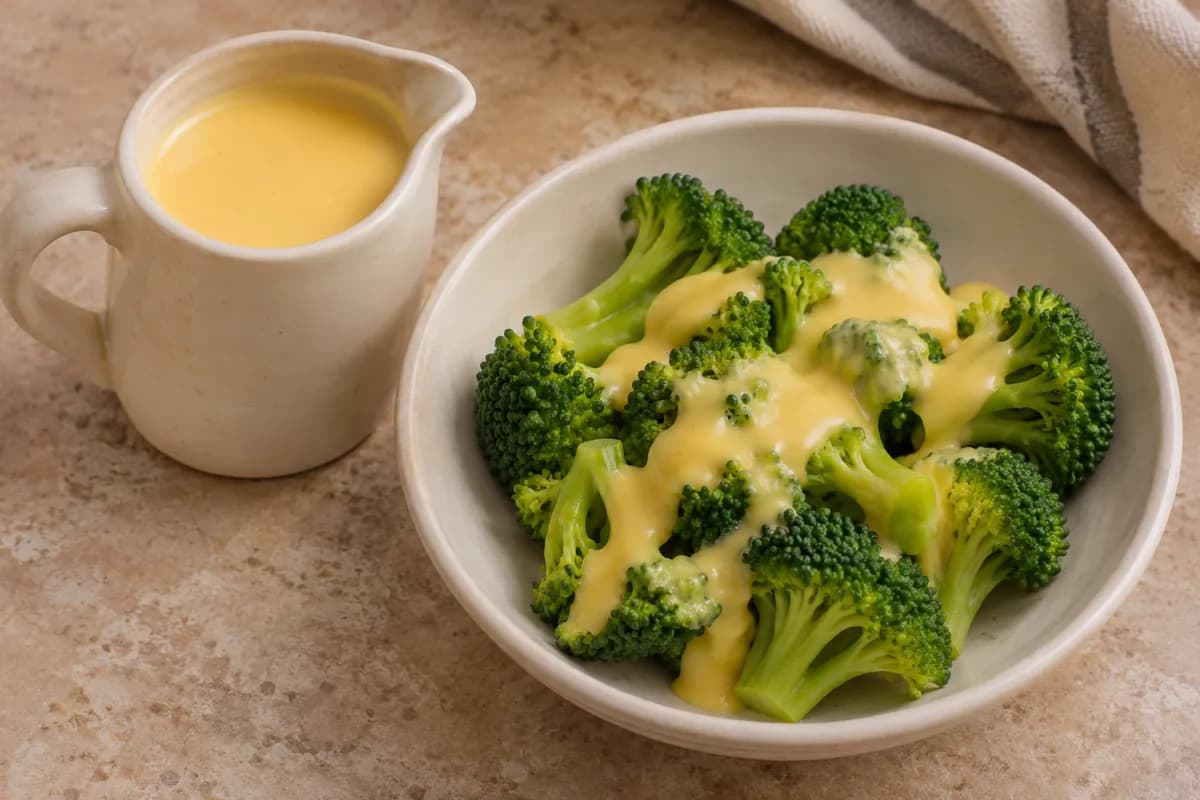
What kind of sauce is this?
This is a cheddar sauce thickened with a small amount of flour. It is designed for pouring over cooked broccoli, rather than baking into a casserole. It contains milk, butter, wheat flour and cheese. It is not a gluten-free or dairy-free recipe.
The sauce should coat the florets while still moving when spooned. It should fall from the spoon in a broad ribbon rather than hold a stiff mound. Choose a cheddar you enjoy eating, then grate it finely. Cheese brands differ in saltiness and texture, so taste the sauce before reaching for extra salt.
Ingredients
For approximately four small sauce portions, prepare:
- 1 tablespoon (14 g) unsalted butter
- 1 tablespoon (8 g) plain all-purpose flour
- ¾ cup (180 ml) whole milk, plus measured extra milk if needed
- 3 ounces (85 g) mild or medium cheddar, finely grated
- ⅛ teaspoon ground black pepper
- Fine salt only after tasting, if needed
- 1 pound (450 g) trimmed broccoli, cooked separately
This makes roughly one cup of sauce, enough to spoon over four small servings of broccoli. For a heavier coating, make a larger batch rather than increasing the cheese alone.
Use a small heavy-bottomed saucepan, a whisk, a flexible spatula and measuring utensils. A very wide frying pan can evaporate the milk faster, so you may need extra milk to keep the sauce pourable.
Get the broccoli ready first
Start the vegetables before the sauce. Cut the broccoli into similar florets and use the steaming guide for a separate cooking method. Drain it thoroughly. Water trapped around the florets can thin the sauce after it reaches the plate.
For plain fresh produce, the FDA recommends washing under running water, without soap. Drying before cooking also makes the preparation easier to control. Keep the cooked broccoli in a clean serving dish while you finish the sauce.
If you prefer browned edges, pair the sauce with roasted broccoli. The sauce itself stays the same, but serve it separately at first so everyone can choose how much coating they want.
How do you make the sauce?
Allow an initial 10–15 minutes for the sauce, plus time for preparing and cooking broccoli. The exact time depends on your saucepan and burner, so watch the consistency as you stir.
- Grate the cheese and measure the milk before turning on the hob. Once the base thickens, you want everything within reach.
- Melt the butter in the saucepan over medium-low heat. Add the flour and whisk until no dry patches remain. Stir for about one minute without letting the mixture turn brown.
- Add roughly one quarter of the milk while whisking. Work it into a smooth paste, then add the remaining milk in two or three additions. Scrape the corners with the spatula if flour collects there.
- Heat gently, stirring, until the base thickens enough to coat the spatula. A few small bubbles are enough. Start checking after three minutes; the exact time depends on the pan and burner.
- Remove the pan from the heat. Add the grated cheddar in three portions, stirring each into the base before adding more. Let the pan's residual heat do the work.
- Stir in the pepper. If the sauce will not flow from a spoon, add one tablespoon of extra milk at a time, stirring well after each addition. Return to very low heat briefly only if unmelted cheese remains.
- Taste a cooled spoonful before adding salt. Pour over the drained broccoli or serve alongside it. Avoid holding the finished sauce at a hard boil.
What if the texture goes wrong?
| Problem | First adjustment | What to change next time |
|---|---|---|
| Too thick | Add milk a tablespoon at a time over gentle heat | Use enough milk for a slow, pourable ribbon |
| Too thin before cheese | Stir the flour-and-milk base a little longer | Use a smaller pan or a slightly longer gentle simmer |
| Grainy after cheese | Remove heat and stir gently; avoid adding more cheese | Use gentle heat and add cheese in small portions |
| Flour lumps | Whisk the milk base smooth before adding cheese | Add milk gradually while whisking |
A badly separated sauce may not return to a perfectly smooth finish. The honest fix is to identify the stage that failed, rather than promising that another handful of cheese will rescue every batch. Do not add dry flour directly to finished sauce; it is difficult to distribute and cook evenly.
Can you make substitutions?
A different cheddar is the simplest change, but it can alter saltiness, color and melting behavior. Use the same weight rather than swapping cheese by a loosely filled cup. Very mature cheese may behave differently from the mild cheddar specified here.
A plant-based drink and dairy-free cheese do not automatically make a working dairy-free version of this recipe. Their thickening and melting properties vary. Choose a recipe written for those ingredients, and check the package labels for allergens.
For a larger batch, double all the ingredients and use a larger saucepan. Do not double the burner setting. Stir along the base and corners so the thickening sauce does not catch. Larger quantities may need more time for the milk base to thicken.
Serving and storage
This sauce suits plain broccoli, baked potatoes or a small plate of mixed vegetables. For a warming bowl rather than a sauce, try broccoli cheddar soup.
Refrigerate sauce and broccoli in separate shallow containers when possible. FoodSafety.gov advises refrigerating perishables within two hours, or one hour above 90°F (32°C). Reheat leftovers to 165°F (74°C), using a thermometer; loosen gently with measured milk if needed. The sauce can become thicker and less glossy after refrigeration; stir patiently rather than boiling it hard.
How should you reheat the broccoli?
If the broccoli has cooled while you finish the sauce, warm the vegetables separately rather than simmering them in the saucepan. Long stirring can break the florets into small pieces and turn a simple side into a very different dish. Add the sauce near the table, with an extra spoon available for serving.
Questions about the recipe
Is pre-shredded cheese forbidden?
No. It is a different product with ingredients that vary by brand. Freshly grated cheddar lets you start with a plain ingredient list and a fine shred that melts easily.
Can you skip the flour?
Not without changing the thickening method. This recipe is built around a flour base; a cornstarch or processed-cheese version needs separate proportions and instructions.
Can the sauce wait while broccoli cooks?
Cook the broccoli first where practical. The sauce thickens as it cools, so a long wait can leave you adjusting it repeatedly instead of serving dinner.
References
- U.S. Food and Drug Administration. (n.d.). Selecting and serving produce safely. Retrieved November 4, 2026.
- FoodSafety.gov. (2023). 4 steps to food safety. Retrieved November 4, 2026.
- FoodSafety.gov. (2024). Cook to a safe minimum internal temperature. Retrieved November 4, 2026.