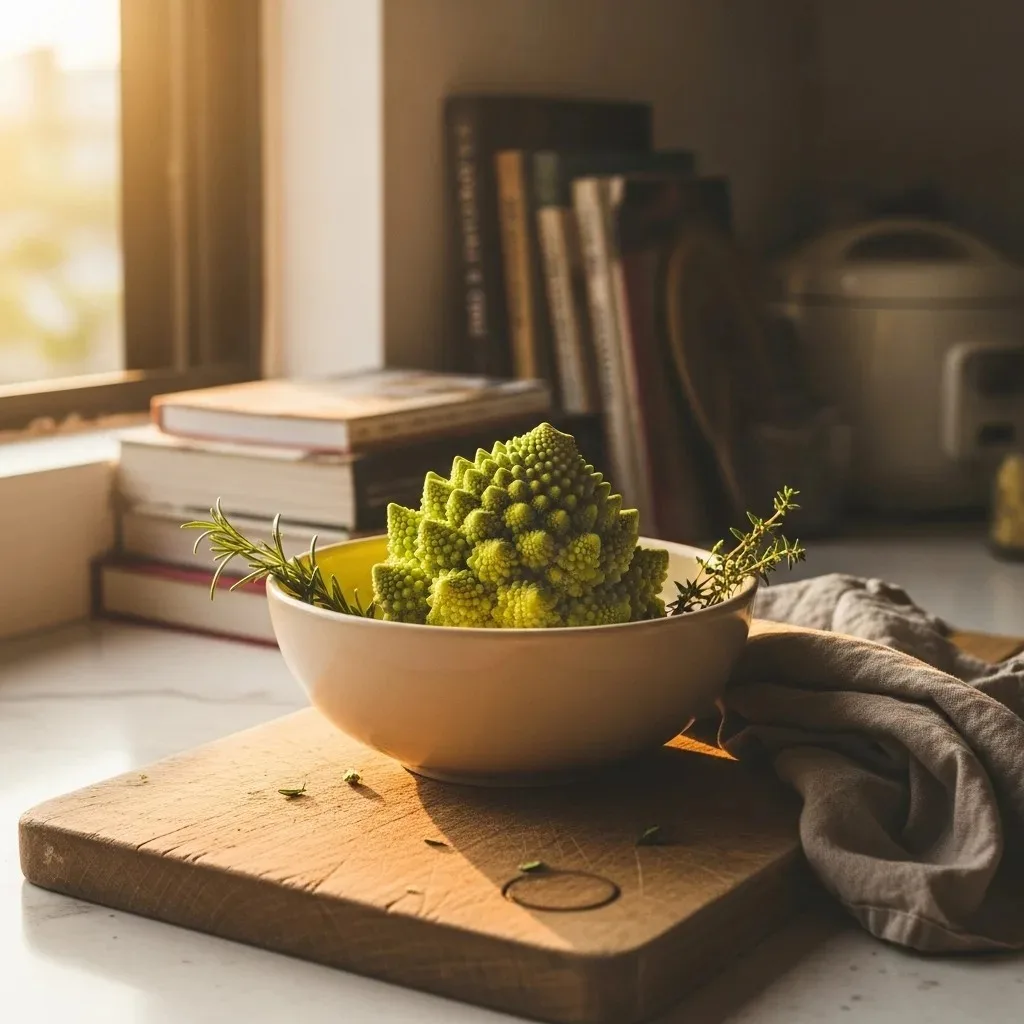
Romanesco: Is It Broccoli or Cauliflower?
Adam spotted it first. We were at the Queensway wet market in 2023, and he was eight years old and fresh off a school unit on Fibonacci numbers, and he picked up this lime-green, spiral-towered vegetable and held it like a trophy. He said, “Mum, this is a math vegetable.” He would not put it down. He carried it the whole way home.
I had no idea what to do with it. I stood in my kitchen Googling “is this broccoli or cauliflower” while Adam drew spirals on a piece of paper next to me. I roasted it with garlic and lemon. He ate the whole bowl. Every time I see it at the market since, I buy it.
Quick Answer
Romanesco is technically a cultivar of cauliflower, classified as Brassica oleracea var. botrytis, the same botanical variety. It is not broccoli, despite often being sold as “romanesco broccoli.” The taste is mild and nutty, closer to cauliflower than broccoli, with far less of the sulphurous bite that puts some people off cruciferous vegetables.
Is Romanesco More Like Cauliflower or Broccoli?
Romanesco is cauliflower. Botanically, it sits inside the same Brassica oleracea var. botrytis classification as white cauliflower, not inside the italica group where broccoli lives. Wisconsin Horticulture Extension states it is “neither broccoli nor cauliflower” as a variety name, but genetically it is a cauliflower cultivar, full stop.
The “broccoli” in its common name is a naming relic, not a botanical fact. In Italy, where it originates, it is called cavolo broccolo romanesco, which roughly means Roman brassica sprout. Marketing stuck with “romanesco broccoli” because the green colour made it seem more broccoli-adjacent. Practically, cook it like cauliflower. It breaks into florets the same way, absorbs oil at the same rate, and goes mushy for the same reasons if you overcook it.
What Does Romanesco Taste Like?
Nutty, mild, and less aggressive than broccoli. That is the honest answer.
The bitterness in regular broccoli comes from a higher concentration of glucosinolates and their sulphurous breakdown products. Romanesco has a lower glucosinolate load, which is why the bite is gentler. Research by Fahey, Zhang, and Talalay confirms glucosinolate concentration varies significantly across Brassica oleracea cultivars, with some producing notably less of the pungent isothiocyanate compounds.
Texture-wise, romanesco holds its shape under heat better than cauliflower, which tends to get waterlogged and soft. Roasted romanesco goes golden at the tips while keeping a slight bite in the thicker stems. Adam described it as “broccoli that decided to be nice.” That tracks.
What Is the Green Fibonacci Vegetable?
Romanesco is the vegetable people mean when they talk about the Fibonacci pattern. Each floret on the head is arranged in a logarithmic spiral, and the number of spirals visible on a romanesco head is always a Fibonacci number: 5, 8, 13.
The fractal geometry
The meristems, the growth points that generate each floret, pack as efficiently as possible using a golden angle of roughly 137.5 degrees between each new floret. It is the same geometry seen in sunflower seeds and pinecone scales. A space-efficiency solution that evolution converged on across unrelated species.
Adam still talks about it at school. He has carried a romanesco to two different show-and-tell sessions.
Where Does Romanesco Come From Originally?
Italy. Specifically the Lazio region around Rome. It was first documented in Italian herbals in the 16th century and was grown exclusively in the area around Rome for a long time before spreading across Europe. The name romanesco just means “from Rome.” It is as Italian as it sounds.
It is an autumn and early winter vegetable, available from September through December. In Singapore, I find it most consistently at Cold Storage or the better wet markets from October onward.
Is Romanesco Healthier Than Broccoli?
They are close, with slightly different profiles. Per 100g raw, romanesco provides roughly 57mg of vitamin C (approximately 63% of the adult RDA) and approximately 16mcg of vitamin K, with around 2.5g of fiber at about 25 calories per 100g. These figures are derived from USDA FDC comparative data for Brassica oleracea cultivars (USDA FDC ID 170379); a dedicated FDC entry for romanesco is pending.
The sulforaphane angle: romanesco contains glucoraphanin, the precursor that converts to sulforaphane during digestion. Research suggests sulforaphane may support cellular health, though I am careful not to overstate this. The practical takeaway from Fahey et al. is that eating romanesco raw or lightly cooked preserves more of these compounds than boiling it.
I do not track macros obsessively, but I care that my kids are getting real vitamins from real food. Romanesco qualifies.
Why Is Romanesco So Expensive?
Short growing season, fussy cultivation, low yield per plant. Romanesco needs specific temperature conditions to form its characteristic heads properly, it takes longer to mature than standard cauliflower, and it bruises and discolours quickly after harvest.
Most supermarkets skip it because it does not travel or hold in cold storage as well as standard cauliflower. When you find it, you are paying for those constraints. Buy the whole head and use all of it.
How Do You Cook Romanesco?
220°C. Florets in olive oil, garlic, salt. Single layer. 20 to 22 minutes. Tips will char slightly. That is the goal. Finish with lemon and parmesan.
6 to 8 minutes until just tender. Lighter result, keeps more colour. Good if you want it as a side without much oil.
200°C for 12 minutes. Crispy edges, shorter wait than oven. Works well for smaller florets.
Do not boil romanesco.
It loses colour, texture, and a significant chunk of water-soluble vitamins including that vitamin C. Raw works fine in crudites. Adam prefers it roasted. Alfi will only eat it if I hide it in pasta, which also works.
FAQs
Can kids eat romanesco?
Yes, and it is often easier to sell than regular broccoli because the taste is milder. The fractal shape helps too. Adam ate it voluntarily the first time, which was a first.
How is romanesco different from broccoflower?
Broccoflower is a separate cultivar, typically a cross between broccoli and cauliflower. It looks like a green cauliflower but without the spiral towers. Romanesco has pointed, helical florets and is botanically classified as a cauliflower cultivar. They are cousins, not the same vegetable.
How do you pick and store romanesco?
Look for a tight, dense head with no browning or yellowing on the floret tips. It should feel heavy for its size. Store unwashed in the crisper drawer in a loose plastic bag for up to five days. Do not wash it until you are ready to cook it.
What flavors pair well with romanesco?
Lemon, garlic, and parmesan are the classic Italian combination. Toasted hazelnuts add a complementary nuttiness. Anchovies work well if your family eats them. The salt and umami offset the mild sweetness well. Alfi cannot detect anchovies if they are melted into the oil first. This is not nutritional advice, just experience.
References
- U.S. Department of Agriculture, Agricultural Research Service. FoodData Central. Broccoli, raw. FDC ID 170379. fdc.nal.usda.gov
- Fahey JW, Zhang Y, Talalay P. (1997). Broccoli sprouts: An exceptionally rich source of inducers of enzymes that protect against chemical carcinogens. Proceedings of the National Academy of Sciences, 94(19), 10367-10372. doi.org/10.1073/pnas.94.19.10367
- University of Wisconsin-Madison Extension Horticulture. “Romanesco.” hort.extension.wisc.edu
Elena Ignacio
Filipino mom of two in Singapore. Cooking in 14+ countries. Writing about broccoli at BroccoliPedia.