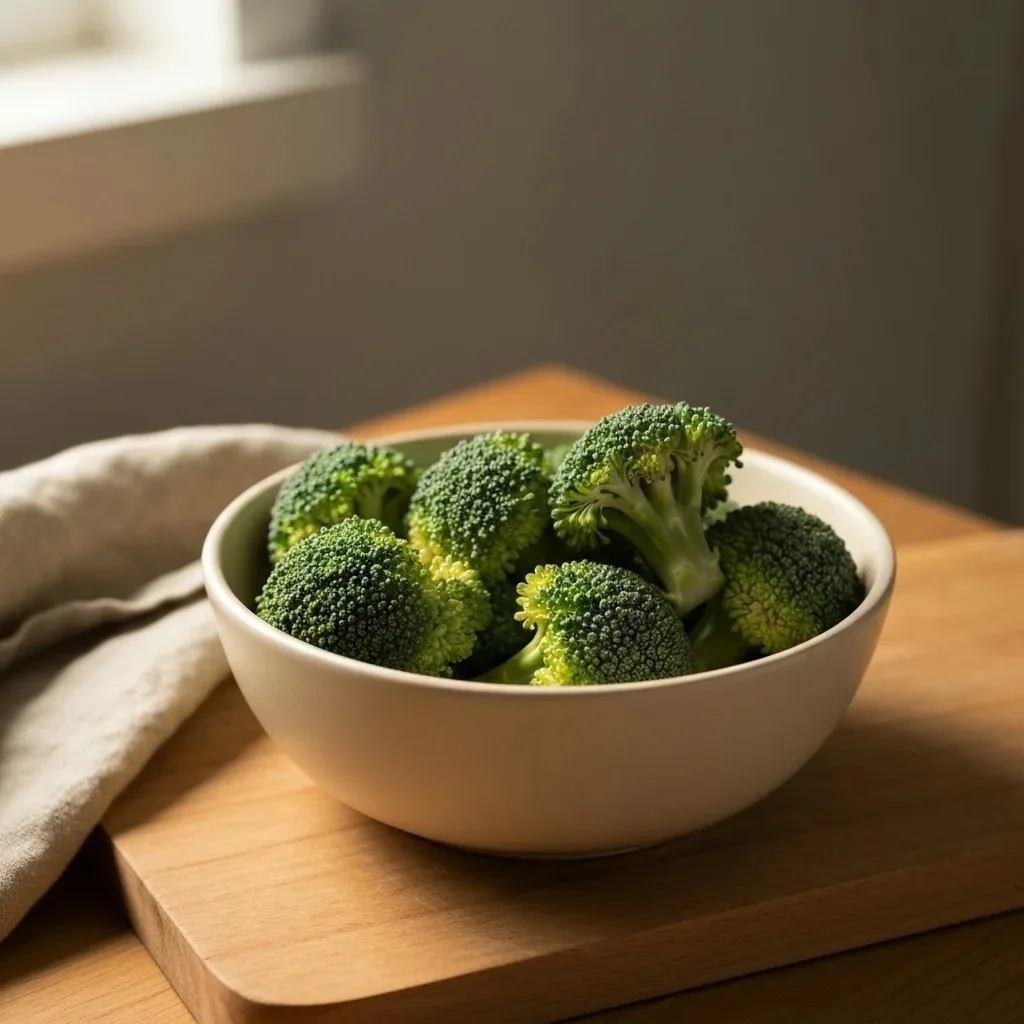
How Many Carbs in Broccoli? (Raw, Cooked, Net Carbs)
In 2022, Adam refused broccoli for three months straight. Called it grass. We were in Singapore, Aditya had just started tracking his macros, and I was trying to make every dinner work within the numbers. I kept a running note on my phone: how much does one cup of broccoli actually count for? That's when I looked it up properly for the first time, and I remember being a little surprised. The number was smaller than I expected.
One cup of raw broccoli (about 90g) has roughly 6 grams of total carbs and around 4 grams of net carbs. Net carbs means total carbs minus fiber. Per 100 grams, USDA FoodData Central puts it at 6.64g total carbs and 4.04g net carbs. That is a genuinely low number. (USDA FDC 170379)
How Many Net Carbs Are in 1 Cup of Broccoli?
Net carbs is the figure that matters if you are on keto or tracking a low-carb diet. The formula is simple: total carbs minus dietary fiber equals net carbs. Your body does not digest fiber the same way it digests sugar, so it has almost no effect on blood sugar.
For one cup of raw broccoli (about 90g), the numbers shake out like this (USDA FDC 170379):
- Total carbohydrates: 5.64g
- Dietary fiber: 2.16g
- Net carbs: approximately 3.4g
If you are using a rounded figure, 6g total and 4g net is what most trackers will show. The exact number depends slightly on whether you measure 90g or 91g, and whether your cup is packed or loosely filled. The range 3.4g to 4g net carbs per cup is accurate and you can use either without concern.
To put that fiber number in perspective: 2.16g of fiber in one cup of broccoli is roughly what you get from half a slice of whole wheat bread. It is not a huge amount, but it is consistent, and it adds up across a day of eating.
How Many Carbs in Broccoli Per 100g?
Per 100g raw, USDA FoodData Central gives us (USDA FDC 170379):
| Nutrient | Per 100g raw | Per 1 cup (90g) raw |
|---|---|---|
| Total Carbohydrates | 6.64g | 5.64g |
| Dietary Fiber | 2.6g | 2.16g |
| Net Carbs (calculated) | 4.04g | ~3.4g |
| Protein | 2.82g | 2.31g |
| Fat | 0.37g | 0.3g |
| Calories | 34 kcal | 35 kcal |
| Vitamin C | 89.2mg | 82.2mg |
| Vitamin K | 102mcg | 91.8mcg |
Source: USDA FoodData Central, FDC ID 170379 (broccoli, raw)
The sugars in broccoli are mostly fructose, sucrose, and glucose. There is very little starch, which is part of why the glycemic impact stays low even though there are some carbs present.
Does Cooking Change the Carb Count?
This one confused me for a while. The short answer: the carbs themselves do not change. Cooking broccoli does not create new sugar or convert fiber into starch.
What changes is the water. When you steam or boil broccoli, it loses water weight, so the same amount of vegetable shrinks in volume. One cup of raw broccoli becomes roughly 0.6 cups of steamed broccoli by volume. If you track by weight, a 90g raw portion stays at about 6g total carbs regardless of how you cook it.
If you track by volume (which most people do), a cup of cooked broccoli contains more grams of broccoli than a cup of raw broccoli. That is why a half-cup of cooked broccoli shows 5.6g total carbs and 3g net carbs. Same broccoli, denser measuring.
The practical takeaway: measure by weight if you want precision. If you are eyeballing a bowl, raw and cooked portions look different but the carb count per gram stays the same.
Is Broccoli Allowed on a Keto Diet?
Yes. Broccoli is one of the most practical keto vegetables.
Most keto targets fall between 20g and 50g net carbs per day. One cup of broccoli at 3.4 to 4g net carbs (USDA FDC 170379) is a small fraction of that allowance. You could eat two or even three cups in a day and still have room in a standard keto budget.
I want to address something that made the rounds in keto communities a few years ago. A popular video claimed one cup of broccoli has zero net carbs. That is not accurate against USDA data. CarbManager, USDA, and every tracker I have used puts it at 3 to 4g net carbs per cup. Not zero. Still very low. But not zero.
Honestly, broccoli is one of the most practical keto vegetables because it also gives you vitamin C, vitamin K, folate, potassium, and bioactive compounds like sulforaphane and beta-carotene. Research suggests these compounds may support anti-inflammatory pathways, though broccoli does not treat or cure any disease. Nutrition alongside a low carb count. That matters more than the exact decimal.
Broccoli vs Cauliflower: Which Has Fewer Carbs?
Cauliflower is the other cruciferous vegetable that keto eaters reach for constantly. The comparison is close. Per 100g raw, cauliflower has about 5g total carbs versus broccoli's 6.64g (USDA FDC 170379). Cauliflower wins by a slim margin, which is why cauliflower rice and cauliflower mash became so popular as substitutes.
That said, broccoli gives you more vitamin C and significantly more vitamin K. Alfi would eat cauliflower all day over broccoli if I let him, but I always mix both into our stir-fry because you get a better nutritional spread that way.
Broccoli Rabe vs Regular Broccoli: What Is the Difference?
Broccoli rabe (also called rapini) is not actually a type of broccoli. It is a different plant in the brassica family, with thinner stems and a bitter flavour. Broccolini is a hybrid of broccoli and Chinese broccoli, with smaller florets and long stalks.
- Regular broccoli: 6.64g total carbs, 4.04g net per 100g (USDA FDC 170379)
- Broccolini: approximately 5g total carbs per 100g
- Broccoli rabe: approximately 2.8g total carbs per 100g (lower than regular broccoli)
If you track carbs closely and find broccoli rabe at the market, it is worth trying. The bitterness pairs well with garlic and olive oil.
FAQs
How many carbs are in 2 cups of cooked broccoli?
Two cups of cooked broccoli contains approximately 11g to 12g of total carbs and 6g to 7g of net carbs. Cooked broccoli is denser by volume than raw, so two cups of cooked holds more vegetable than two cups of raw.
Can I eat broccoli on a no-carb diet?
No vegetable is truly zero carbs. Broccoli has 3.4 to 4g net carbs per cup (USDA FDC 170379), so a no-carb diet (meaning genuinely zero) would exclude it. If you mean a very low carb or keto diet, broccoli fits easily.
What is the lowest-carb vegetable?
Spinach, cucumber, and celery typically come in lower than broccoli at around 1 to 2g net carbs per 100g. Lettuce is even lower. Broccoli rabe sits around 2.8g per 100g. Broccoli at 4g net carbs is not the lowest, but it is close and comes with more nutrition than most of the lower-carb options.
Is 2 cups of broccoli a day too much?
For most people, no. Two cups gives you about 8g net carbs, a strong dose of vitamin C at roughly 178mg (about double the 90mg daily recommended value), and significant vitamin K at 204mcg. Research suggests eating cruciferous vegetables several times a week is associated with positive health outcomes. If you are on blood thinners, the high vitamin K content is worth discussing with a doctor since it affects clotting.
Sources
- USDA FoodData Central, FDC ID 170379. Broccoli, raw. fdc.nal.usda.gov
- Healthline. Broccoli 101: Nutrition Facts and Health Benefits. healthline.com
- CarbManager. Broccoli, cooked from fresh. carbmanager.com
- USDA SNAP-Ed Seasonal Produce Guide. Broccoli. snaped.fns.usda.gov
- N.C. Cooperative Extension. Broccoli Nutrition Facts. franklin.ces.ncsu.edu